Shipping Box Strength Ratings: ECT and Burst Test Explained
Two cardboard boxes can look identical and perform completely differently once they are loaded, stacked and sent through a shipping network. One holds its shape under a pile of other parcels. The other buckles at the corners and arrives crushed. The difference is box strength, and it is printed right on many boxes if you know where to look.
This guide explains how box strength is measured, what ECT and burst test ratings mean, how to read the box maker’s certificate, and how to choose a box that is strong enough for your item without overspending on heavy-duty cardboard you do not need.
How corrugated boxes are built
A corrugated box is made from layers of paperboard. The flat outer layers are called liners, and the wavy layer between them is called the fluting or medium. The flutes act like a row of tiny arches, which is what gives corrugated board its stiffness and cushioning.
- Single wall: one layer of fluting between two liners. This is the everyday shipping box and works for most household and small business parcels.
- Double wall: two layers of fluting and three liners. Stronger and more puncture resistant, suited to heavier or more valuable items and to double boxing.
- Triple wall: three layers of fluting. Built for very heavy loads and industrial use, and usually more than a parcel shipment needs.
Flute sizes also vary. Larger flutes give more cushioning and stacking strength, while smaller flutes give a smoother surface for printing and better resistance to crushing on the flat. For most parcel shipping, a standard single wall or double wall box is the practical choice.
The two main strength ratings
Edge Crush Test (ECT)
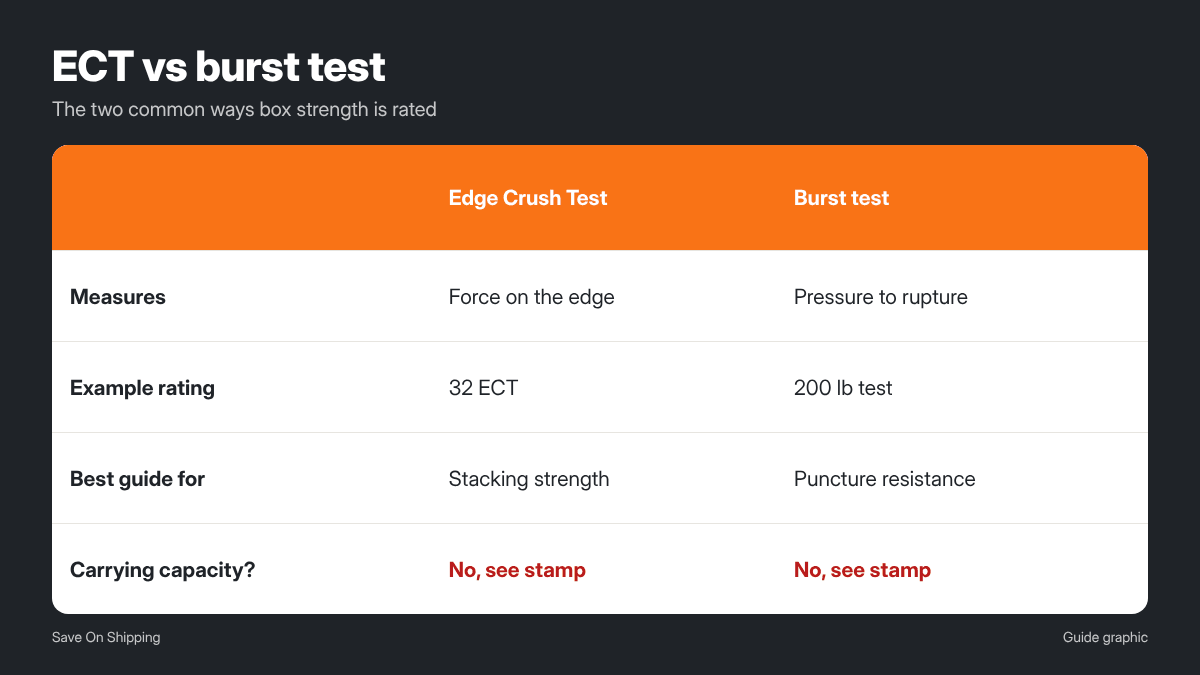
The Edge Crush Test measures how much force the board can withstand on its edge before it crushes. That matters because when boxes are stacked, the weight presses down on the vertical walls. ECT is expressed as a number, such as 32 ECT or 44 ECT, which represents pounds of force per inch of edge. A higher number means the box resists stacking pressure better.
Mullen burst test
The burst test measures how much pressure it takes to rupture the board’s surface, a bit like pushing a fist through the side. It is expressed in pounds per square inch, so you will see ratings like 200 lb test or 275 lb test. A higher number means the walls resist punctures and rough handling better.
Which rating matters more for parcels?
Both are useful. ECT is the better guide for stacking strength, which is a big part of what happens to a parcel in trucks and sorting centers. The burst test is a better guide for puncture resistance and for boxes that will be handled roughly or carry heavy, dense contents. Many common boxes are rated by one method or the other, and either is fine as long as you choose an appropriate level.
How to read the box maker’s certificate
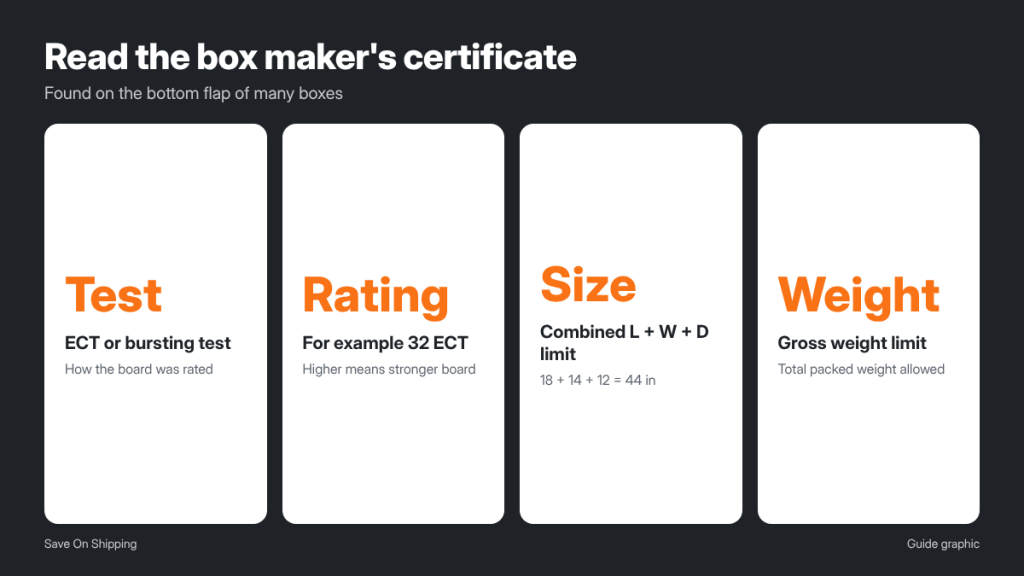
Many corrugated boxes carry a round or square stamp, usually on the bottom flap, called the box maker’s certificate. It typically shows:
- The test type: Edge Crush Test or Bursting Test.
- The rating: for example, 32 ECT or 200 lb.
- Single, double or triple wall construction, in some cases.
- Size limit: the maximum combined length, width and depth in inches that the box is certified for.
- Gross weight limit: the maximum total weight in pounds, including contents, that the box is certified to carry.
- The manufacturer and location.
The weight limit is the most practical number on the stamp. If your packed box weighs more than the certified gross weight, it is overloaded and more likely to fail. If a box has no certificate at all, treat it as unknown and use it only for light, non-fragile items.
Checking the size limit
The size limit is the sum of the three outside dimensions. A box measuring 18 x 14 x 12 inches has a combined size of 18 + 14 + 12 = 44 inches. Compare that number with the size limit on the stamp to confirm the box is within its certified range.
How to choose the right strength for your item
Match the box to the weight, the fragility and how the package will be handled. These general guidelines work for most parcel shipments:
- Light, soft items such as clothing, linens or paper goods: a standard single wall box, or a poly mailer if the item does not need crush protection.
- Everyday household items of moderate weight: a single wall box with a common rating like 32 ECT or 200 lb test, within the weight limit on the stamp.
- Heavy or dense items such as books, tools or small appliances: a higher ECT or burst rating, or a double wall box, and smaller box sizes so weight is spread across less unsupported wall.
- Fragile or valuable items: double wall, or a double-box setup with a sturdy outer box.
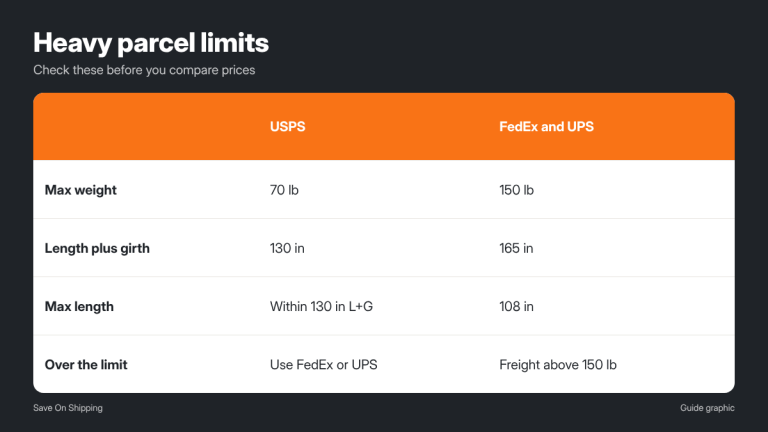
- Very heavy items close to carrier parcel weight limits: double wall at minimum, reinforced tape and corner protection, or consider whether freight is a better fit.
Remember that box strength is only one part of protection. Cushioning, filling empty space and sealing the box properly matter just as much. A strong box packed loosely can still lead to broken contents.
Factors that weaken a box
A box’s rating describes it when it is new and dry. Several things reduce its real strength:
- Moisture and humidity. Corrugated board absorbs moisture and loses stiffness. Store boxes in a dry place, especially in humid climates.
- Reuse. Each trip through a shipping network weakens the board, flattens flutes and creases walls.
- Holes and cutouts. Handholds and cut-down sections reduce wall strength. Reinforce cut-down boxes with extra tape.
- Overhang on pallets or shelves. If part of the box is unsupported, the walls carry more load in a smaller area.
- Underfilling. An empty box collapses easily when stacked. Filling space supports the walls from the inside.
- Overfilling. A bulging box puts the walls and seams under constant strain.
Worked example: checking a heavy box
You are shipping a set of cast iron pans. Packed with cushioning, the box will weigh about 32 pounds. The box you have is a single wall box measuring 16 x 16 x 12 inches, and its certificate shows a combined size limit and a gross weight limit. First, add the dimensions: 16 + 16 + 12 = 44 inches, which you compare with the size limit. Then compare the 32 pound packed weight with the gross weight limit. If the weight is close to or above the limit, move to a double wall box or a box with a higher rating. Dense, heavy items like these also benefit from extra tape along the bottom seams and a layer of cushioning under the load.
A quick checklist before you ship
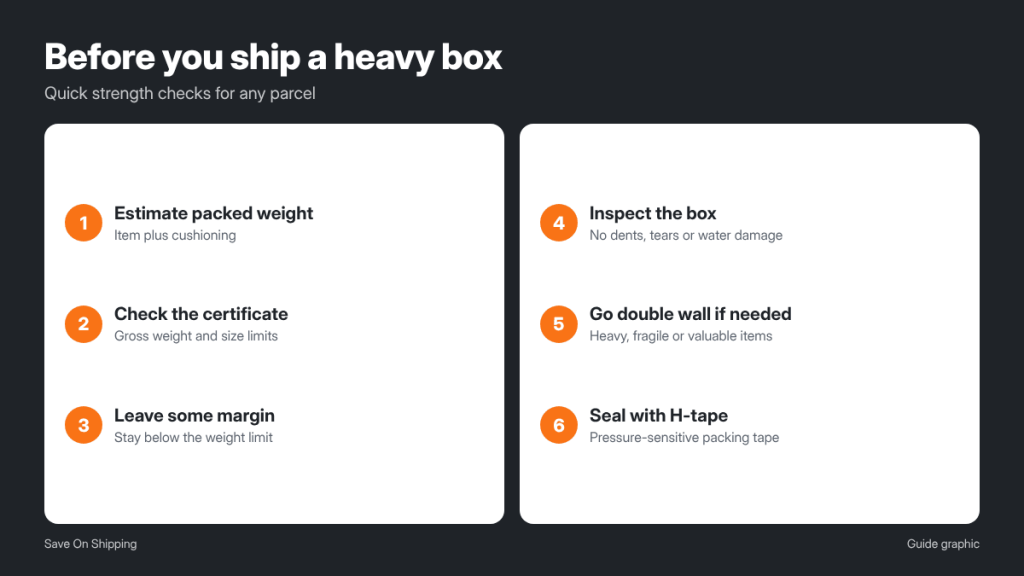
- Weigh the item with its cushioning and estimate the packed weight.
- Check the box maker’s certificate for the gross weight limit and size limit.
- Confirm the packed weight is below the limit, ideally with some margin.
- Inspect the box for dents, tears, water damage and flattened corners.
- Choose double wall or double boxing for fragile, heavy or high-value contents.
- Seal with pressure-sensitive tape using the H-tape method.
Frequently asked questions
What does 32 ECT mean on a box?
It means the corrugated board passed an Edge Crush Test rating of 32 pounds per inch. It is a common rating for everyday single wall shipping boxes and indicates good stacking strength for typical parcels.
Is a 200 lb test box rated to carry 200 pounds?
No. The 200 lb figure is a burst strength measured in pounds per square inch, not the box’s carrying capacity. The gross weight limit is listed separately on the box maker’s certificate.
Is double wall always better?
It is stronger, but it is also heavier and costs more. For light, sturdy items, a quality single wall box is usually enough. Save double wall for heavy, fragile or valuable contents.
What if my box has no certificate?
Treat its strength as unknown. Use it for light, non-fragile items only, or choose a certified box for anything heavy or valuable.
Not sure your box is strong enough?
Houston shippers can pick up certified boxes and get packing help at The Postal Spot’s UPS shipping counter, where staff can match the box to your item’s weight.