Mail-In vs In-Store Returns: Which Is Faster and Easier
When a retailer has both a website and physical stores, you often get to choose how to send something back. You can box it up and mail it, or carry it into a store and hand it over at the counter. Each route has real advantages, and the faster or cheaper one depends on the item, the retailer’s policy and where you live.
This guide compares mail-in and in-store returns on speed, cost, convenience and proof. It walks through how each process works, when one clearly beats the other, and a third option many shoppers overlook: dropping a prepaid return at a staffed shipping location. By the end, you will know which route to pick for any return.
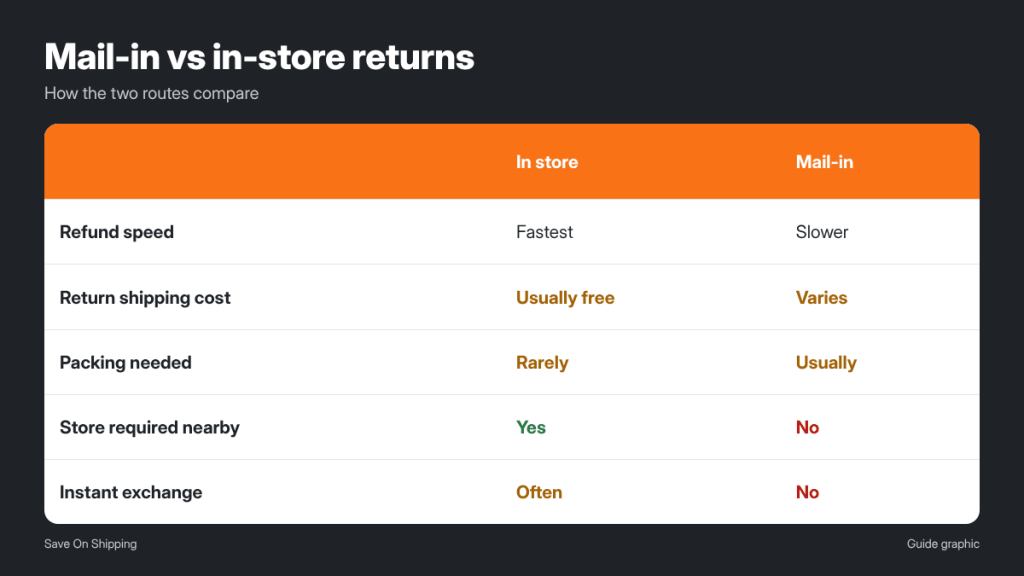
How an in-store return works
An in-store return usually follows the same basic steps:
- Check that the retailer accepts online orders back in its stores. Most large chains do, but some exclude certain items or marketplace purchases.
- Bring the item, your order number or receipt, and the payment card you used.
- Go to the customer service or returns counter. Staff inspect the item and process the return on the spot.
- Leave with a receipt showing the refund, exchange or store credit.
Advantages of returning in store
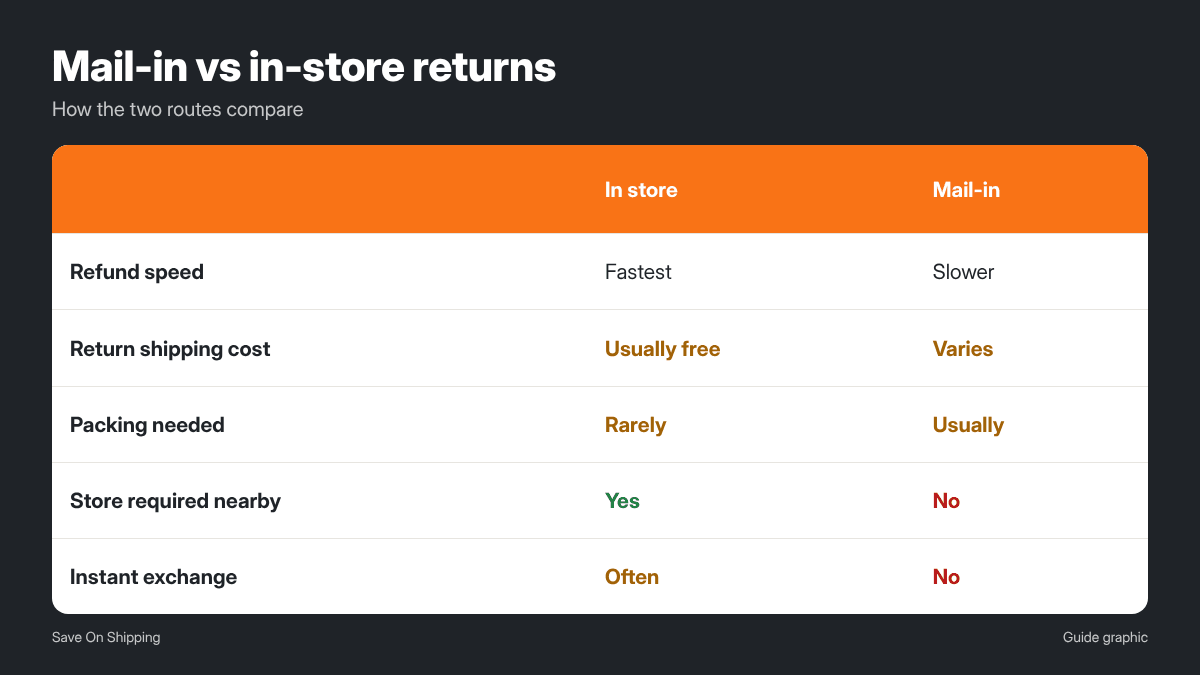
- Faster refunds. The return is processed immediately, so you skip the transit and warehouse processing time.
- No return shipping cost. In-store returns are usually free, even when the retailer charges for mail-in returns.
- Instant exchanges. If the right size or color is in stock, you can swap on the spot.
- No packing. You can usually bring the item without a shipping box.
- Clear proof. You get a receipt confirming the return was accepted.
Drawbacks
- You need a store nearby, and the trip costs time and fuel.
- Store hours and lines can be inconvenient, especially after the holidays.
- Large or heavy items are awkward to carry.
- Some items bought online may not be accepted in store.
How a mail-in return works
- Start the return on the retailer’s website or app and select the items and reason.
- Get a prepaid return label or a QR code, or create your own label if the retailer requires it.
- Pack the item securely, include any return slip, and attach the label.
- Drop it off with the carrier or schedule a pickup.
- Track the package and wait for the retailer to process the refund.
Advantages of mailing it back
- No store required. Works for online-only retailers and stores far from you.
- Flexible timing. You can drop it off whenever is convenient, often at many locations.
- Handles awkward items. Heavy or bulky items can be picked up rather than carried.
- Multiple returns at once. You can drop several returns from different retailers in a single trip.
Drawbacks
- Slower refunds. You wait for transit and processing before the money comes back.
- Possible shipping cost. Some retailers deduct a return shipping cost or ask you to pay for a label.
- Packing required. You need a suitable box or mailer.
- Proof depends on you. Without a drop-off receipt or acceptance scan, you may have little evidence if the package goes missing.
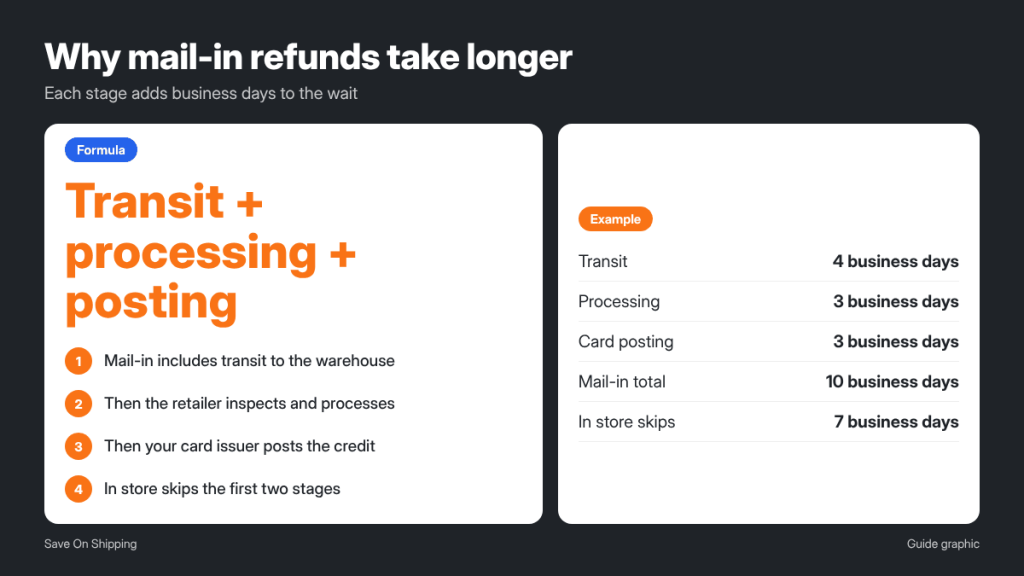
Speed: which gets your money back faster
In-store returns usually win on speed, because the retailer processes the return immediately. With a mail-in return, the clock includes transit time, warehouse processing and the time your card issuer takes to post the credit.
Worked example
Say a mail-in return takes 4 business days in transit, 3 business days for the retailer to process, and 3 business days for your card issuer to post the credit. That totals 4 + 3 + 3 = 10 business days, or two full weeks on the calendar. An in-store return processed today skips the first 7 of those business days, leaving only the card issuer’s posting time. If you need the money back quickly, the store usually wins.
Cost: which saves you money
Compare the full cost of each option, not just the label:
- Return shipping charge: free, deducted from your refund, or paid by you.
- Restocking fee: usually the same either way, but check the policy.
- Your travel: a long drive to a store has a real cost in fuel and time.
- Packing materials: mail-in returns may require a box and tape.
If the retailer charges for mail-in returns but a store is on your normal route, the store is usually cheaper. If the store is far away and the retailer offers a free prepaid label, mailing it is often the better choice.
A middle option: staffed drop-off locations
Many retailers now offer return labels and QR codes that can be used at carrier counters and authorized shipping stores. This option combines some of the benefits of both routes:
- No store from that retailer needs to be nearby.
- Staff can scan the package in front of you and give you a receipt.
- Some locations accept returns without a box for certain retailers and carriers.
- You can drop off returns for several retailers and carriers in one visit.
The refund still waits on transit and processing, but you gain stronger proof and less hassle than leaving a package in a drop box.
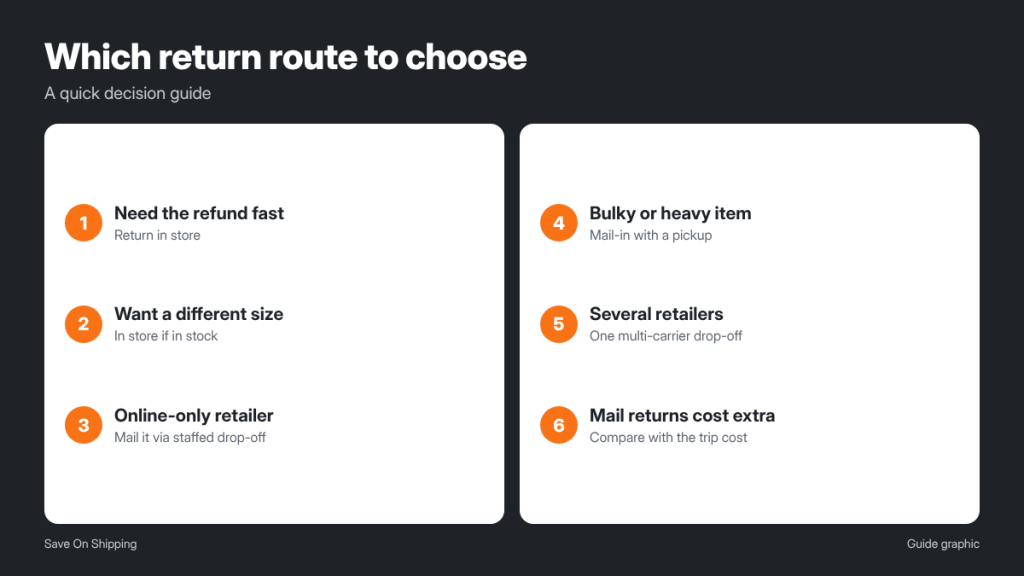
How to choose: a quick decision guide
- Need the refund fast? Return in store if possible.
- Want an exchange for a different size? In store, if the item is in stock there.
- Online-only retailer? Mail it, ideally through a staffed drop-off point.
- Bulky or heavy item? Mail-in with a pickup, or check whether the store will accept it.
- Several returns from different retailers? Drop them off together at a multi-carrier location.
- Retailer charges for mail returns? Compare that charge with the cost of a trip to the store.
Three common scenarios
- A sweater in the wrong size from a chain with a store nearby: take it to the store. You can likely swap for the right size on the spot, and there is no shipping cost.
- A phone case from an online-only shop with a free prepaid label: mail it back, ideally at a staffed drop-off where you get a scan receipt. The item is small and easy to pack.
- A floor lamp from a retailer that charges for mail-in returns, with the nearest store an hour away: compare the return shipping charge with the cost and time of the drive. Also ask the retailer whether a pickup or returnless refund is available for bulky items.
What retailers check when your return arrives
Whichever route you choose, the retailer inspects the item before approving the refund. In store, that happens in front of you. With a mail-in return, it happens at a warehouse, which is one reason refunds take longer. Typical checks include whether the item matches the order, whether it is in the required condition, whether all parts and accessories are included and whether tags and packaging are present if the policy requires them. Packing the item carefully, with every accessory in the box, reduces the chance of a reduced or delayed refund.
Tips for either route
- Start the return before the window closes, not just before the item arrives back.
- Keep tags, accessories and packaging until you decide.
- Take photos of the item before returning it, especially if it is damaged.
- Always get a receipt or scan confirmation.
- Watch your account or card for the refund, and follow up if it does not appear within the stated time.
Frequently asked questions
Can I return an online order in store?
Many retailers allow it, but not all, and some exclude certain items or marketplace sellers. Check the retailer’s return policy before you go.
Is an in-store return always faster?
Usually, because it is processed on the spot. The only wait is for your card issuer to post the refund.
What proof should I keep for a mail-in return?
Keep the return confirmation, the tracking number and a drop-off receipt or acceptance scan showing the carrier received the package.
Do I need a box for a mail-in return?
Often, but some retailers and carriers offer boxless returns at specific drop-off locations using a QR code. Check the return instructions.
Have returns from several stores?
The Postal Spot accepts package drop-offs in Houston for FedEx, UPS, USPS and Amazon returns, so you can hand them all over in one stop and keep a receipt.