Dimensional Weight Explained: Why Your Box Size Changes the Shipping Price
You weigh a package at 4 pounds, but the shipping price looks like it was calculated for 12. That is not a mistake. It is dimensional weight, and it is one of the main reasons shipping costs surprise people. Since USPS updated its rules in July 2026, all three major carriers now calculate dimensional weight the same way, so understanding it is the easiest way to stop paying for air.
This guide explains what dimensional weight is, how to calculate it, how USPS, FedEx and UPS apply it, and practical ways to keep it from inflating your shipping bill.
What is dimensional weight?
Dimensional weight, often shortened to DIM weight, is a pricing method that accounts for how much space a package takes up in a truck or plane, not just how heavy it is. A large box of pillows weighs very little but fills the same cargo space as a box of books. Carriers use dimensional weight so they get paid fairly for that space.
For every package, the carrier compares two numbers:
- Actual weight: what the package weighs on a scale.
- Dimensional weight: a weight calculated from the box’s length, width and height.
Whichever number is higher becomes the billable weight, and that is what your price is based on.
How to calculate dimensional weight
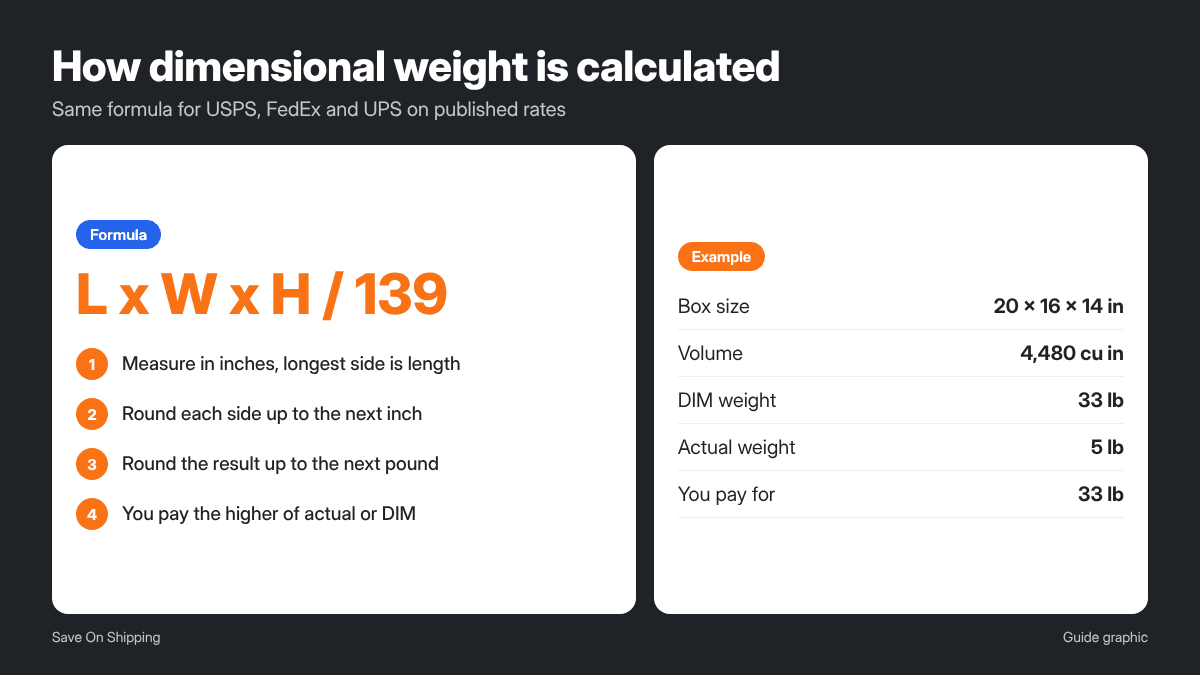
The formula is the same for all three major carriers on their standard published rates:
Length x Width x Height (in inches) / 139 = dimensional weight in pounds
A few rules to follow:
- Measure the longest side as the length, and measure to the outside of the box, including any bulges.
- Round each measurement up to the next whole inch. A side of 12.2 inches counts as 13.
- Round the final result up to the next whole pound.
Worked example
You are shipping a lamp shade in a 20 x 16 x 14 inch box. It weighs 5 pounds.
- Volume: 20 x 16 x 14 = 4,480 cubic inches
- Dimensional weight: 4,480 / 139 = 32.2, rounded up to 33 pounds
- Billable weight: 33 pounds, because 33 is higher than 5
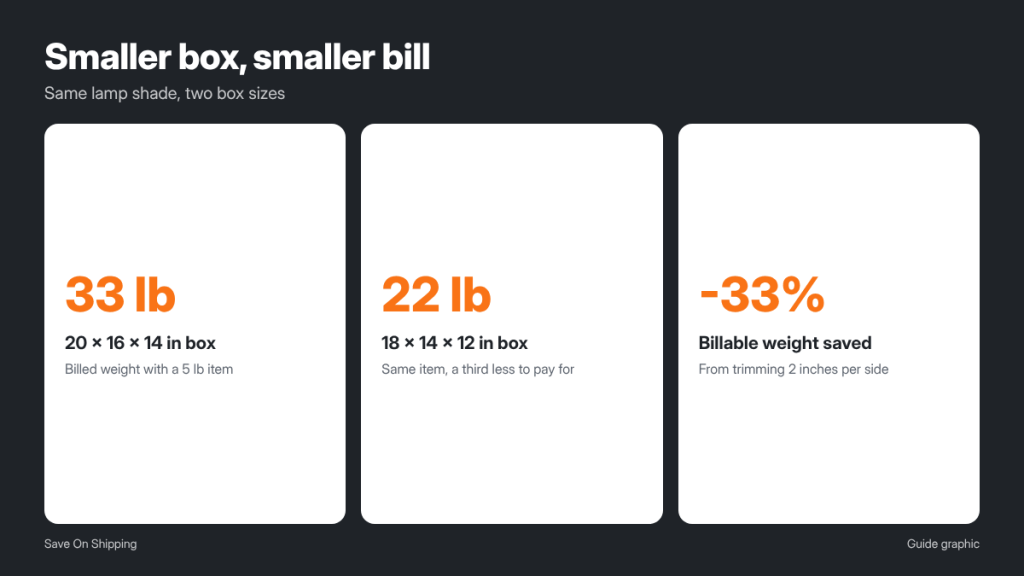
You will pay the 33 pound rate, more than six times the actual weight. If you could fit the same item in an 18 x 14 x 12 inch box, the dimensional weight would drop to 22 pounds.
How each carrier applies dimensional weight
USPS
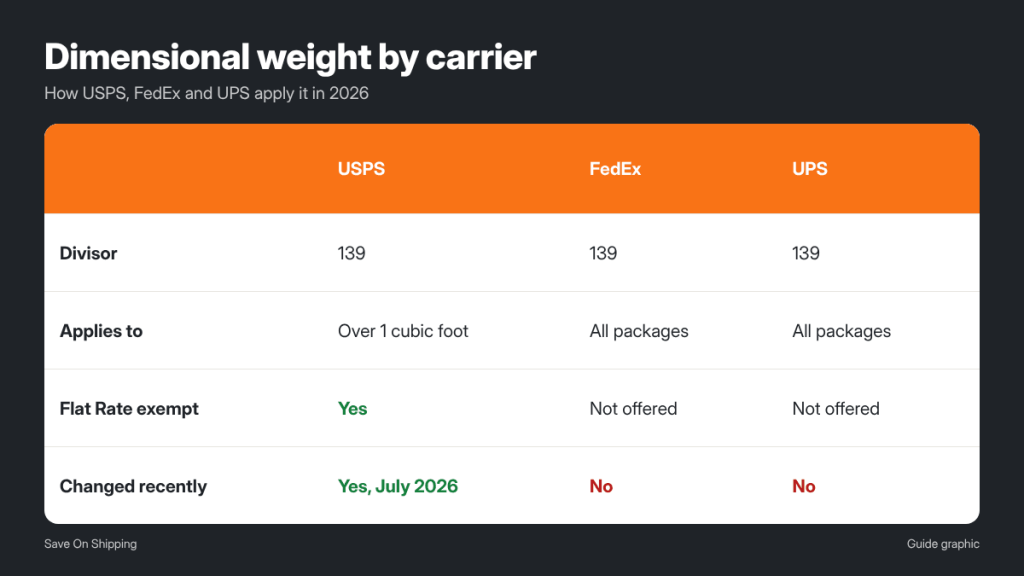
Since July 12, 2026, USPS uses a divisor of 139, down from 166, and rounds each fractional inch up. That change made DIM weight higher for larger boxes. USPS applies dimensional weight only to packages larger than 1 cubic foot (1,728 cubic inches). Smaller boxes are still priced by actual weight, which is one reason USPS is often the best value for compact packages. Dimensional pricing applies to Priority Mail, Priority Mail Express, USPS Ground Advantage and Parcel Select. Flat Rate boxes and envelopes are not affected, since you pay one price regardless of weight up to the limit.
FedEx
FedEx applies dimensional weight to all packages on its standard rates, regardless of size, using the 139 divisor. Even a small box can be billed above its actual weight if it is very light for its size.
UPS
UPS also uses 139 for daily rates and applies DIM weight to all package sizes. Like FedEx, accounts with negotiated contracts may have different divisors, so business shippers should check their agreements.
Seven ways to lower your dimensional weight charges
- Right-size your boxes. Keep several box sizes so every item ships in the smallest box that protects it. Shaving 2 inches off each side of a medium box can cut the billable weight by a third.
- Use poly mailers for soft goods. Clothing, linens and other soft items ship well in mailers, which have almost no wasted space.
- Cut down oversized boxes. If you only have a large box, score and fold it down to fit the item. Many packing stores do this routinely.
- Choose cushioning that compresses. Crumpled paper or air pillows can fill gaps without forcing a larger box.
- Use Flat Rate for heavy, compact items. A small, dense item like tools or books often ships cheaper in a USPS Flat Rate box, which ignores both weight and dimensions within the limit.
- Compare carriers per package. Because USPS ignores DIM weight under 1 cubic foot and FedEx and UPS do not, the cheapest carrier changes with box size. Shipping software makes this comparison quick.
- Combine orders. One slightly larger box can be cheaper than two separate boxes, especially when each is billed at a minimum.
Dimensional weight in real life: three common shipments
Seeing the math on everyday items makes it easier to spot where you are losing money.
A pair of sneakers
A shoe box shipped inside a 14 x 10 x 6 inch shipping box is 840 cubic inches. With USPS, that is under 1 cubic foot, so you pay for the actual weight of about 3 pounds. With FedEx or UPS, the dimensional weight is 840 / 139 = 6.04, rounded up to 7 pounds, so you are billed for 7. For this package, USPS Ground Advantage usually wins.
A countertop appliance
An air fryer in an 18 x 16 x 16 inch box weighing 12 pounds has a dimensional weight of 4,608 / 139 = 33.2, rounded up to 34 pounds on all three carriers. Here, the size of the box matters far more than the weight, and the cheapest option depends on distance and service level. If the retail box can ship as is with a label, without an extra outer box, the billable weight drops considerably.
A box of hardcover books
Books are dense. A 12 x 12 x 8 inch box (1,152 cubic inches) full of books may weigh 25 pounds, while its dimensional weight is only 9 pounds. The actual weight is billed, and a USPS Flat Rate box is often the best deal for heavy, compact loads like this.
The pattern is simple: light and bulky items are hit hardest by dimensional weight, while small and heavy items are priced by the scale. Knowing which group your products fall into tells you where to focus your packaging changes.
Common mistakes that trigger extra charges
- Entering wrong dimensions. Carriers measure packages automatically in their hubs. If your declared size is smaller than the real size, you will be billed an adjustment later, sometimes with a fee.
- Forgetting the bulge. An overstuffed box measures larger than its printed size.
- Shipping in reused retail boxes. Product boxes are often much larger than needed and may also have old barcodes that confuse sorting.
- Ignoring additional handling thresholds. Very long or heavy packages can also trigger separate surcharges on top of DIM pricing.
Frequently asked questions
Does dimensional weight apply to every package?
For FedEx and UPS standard rates, yes. For USPS, only packages larger than 1 cubic foot are priced by dimensional weight.
Why did my USPS shipping cost go up in 2026?
USPS changed its divisor from 166 to 139 in July 2026 and started rounding fractional inches up, so larger boxes now calculate a higher dimensional weight than before.
Is dimensional weight the same as volumetric weight?
Yes. Volumetric weight is the term more common in international shipping. The concept is the same, though international divisors can differ.
How do I know which carrier is cheapest for my box?
Calculate the billable weight for each carrier, or use shipping software or a multi-carrier shipping store that compares rates side by side.
Not sure which carrier is cheapest for your package?
In Houston, The Postal Spot compares FedEx, UPS and USPS rates at the counter and can repack items into a smaller box to bring your shipping cost down.