How to Read a Shipping Invoice and Catch Billing Adjustments
You paid for a label, the package was delivered, and you thought the transaction was finished. Then a week or two later, a charge appears on your carrier account or invoice that you did not expect. These after-the-fact charges are called billing adjustments, and for anyone who ships regularly, they can quietly add a meaningful amount to the true cost of shipping.
This guide explains how to read a shipping invoice line by line, what the most common adjustments mean, why they happen, and how to prevent them. You will also learn how to dispute a charge that looks wrong and how to set up a simple monthly review so nothing slips past you.
Why shipping charges change after you ship
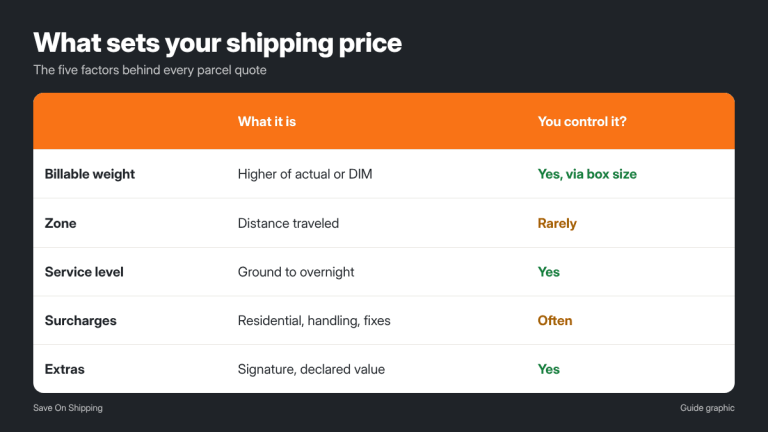
When you create a label, the price is based on the information you enter: weight, dimensions, service, destination and any extras. That price is an estimate built on your data. Once the package enters the carrier’s network, automated equipment weighs and measures it, and the address is checked against the carrier’s records.
If the carrier’s measurements or findings differ from what you entered, it recalculates the charge and bills the difference. This process is often called an audit. It is normal and expected, so the goal is not to avoid audits but to make sure your label data matches reality so the audit finds nothing to change.
The parts of a shipping invoice
Invoice layouts vary by carrier and by how you ship, but most include the same core sections. Learning to find them makes every review faster.
Account summary
The top of the invoice usually shows the account number, billing period, total due and payment due date. Check that the account and period are what you expect before you look at anything else.
Shipment detail
Each shipment typically appears as its own line or block, with the tracking number, ship date, service, origin and destination ZIP codes, zone, entered weight, billed weight and the base charge. This is where most of your review time goes.
Accessorial charges
These are the add-ons and surcharges tied to each shipment: fuel, residential delivery, delivery area, additional handling, signature options and declared value. They may be listed under the shipment or grouped separately.
Adjustments section
Corrections to earlier shipments often appear in a dedicated adjustments area, sometimes on a later invoice than the original shipment. Look for words like correction, adjustment, audit or reclassification.
The most common billing adjustments
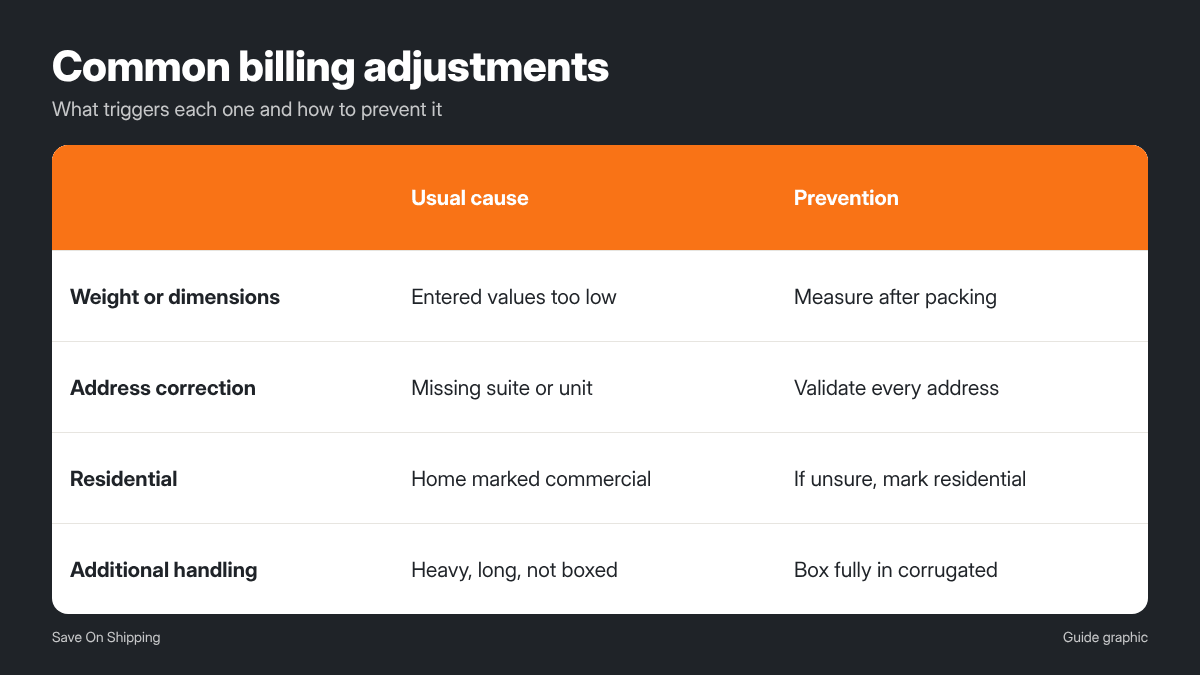
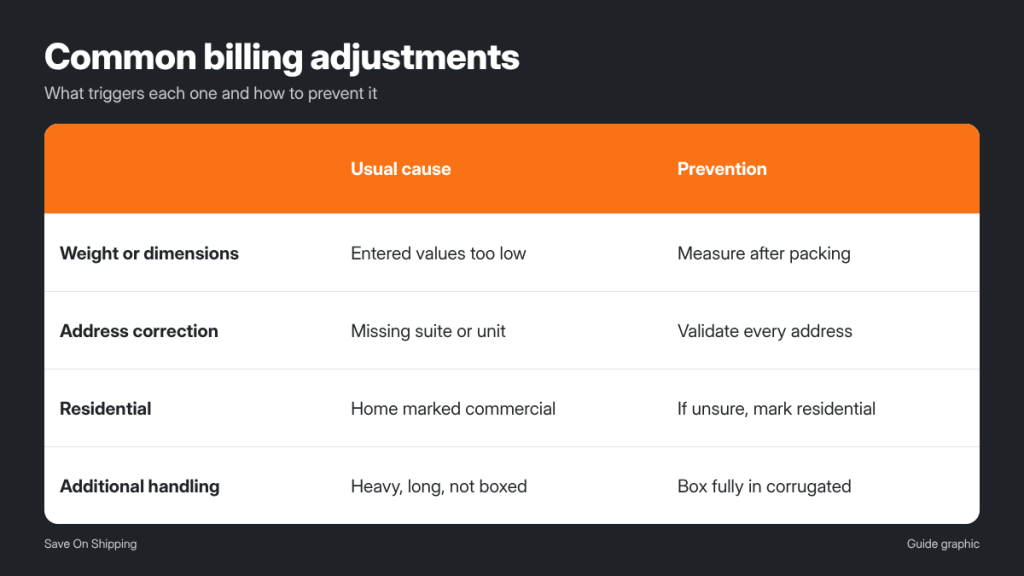
Weight and dimension corrections
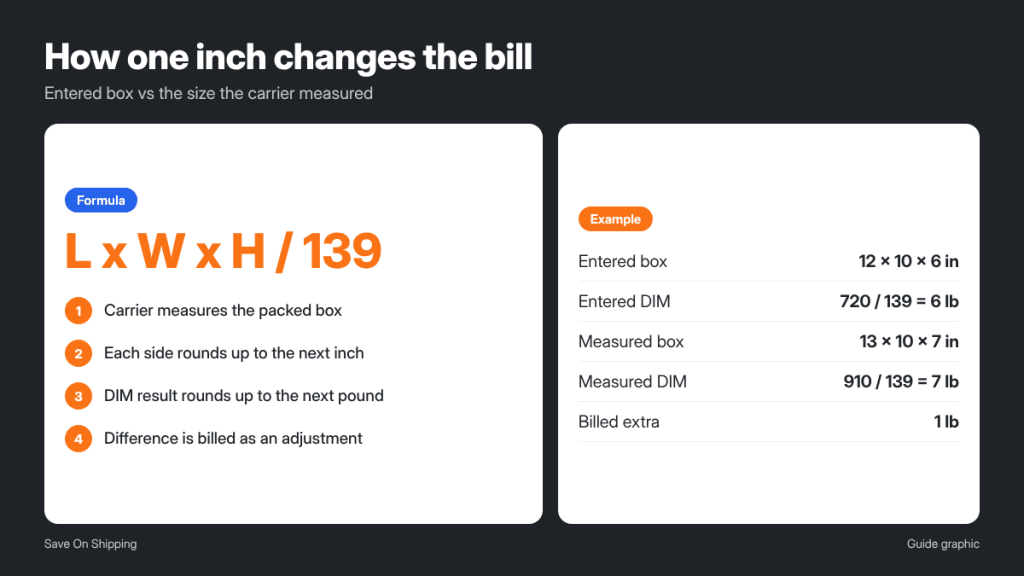
This is the most frequent adjustment. If you entered 4 pounds and the carrier’s scale reads 5, or you entered a 12 x 10 x 6 inch box that measures 13 x 10 x 7, the billable weight is recalculated. Because FedEx and UPS use dimensional weight on all packages, even a one-inch difference on one side can change the price.
Here is how one inch adds up. A 12 x 10 x 6 inch box is 720 cubic inches. 720 / 139 = 5.2, which rounds up to 6 pounds. A 13 x 10 x 7 inch box is 910 cubic inches. 910 / 139 = 6.5, which rounds up to 7 pounds. If the item inside weighs 3 pounds, you entered a billable weight of 6 but the carrier bills 7.
Address corrections
If the address is incomplete or incorrect and the carrier corrects it to deliver the package, an address correction charge may be added. Missing suite and apartment numbers are a common cause.
Residential reclassification
If you shipped to an address marked as commercial but the carrier determines it is a residence, the residential surcharge is added after the fact. Home-based businesses are a frequent source of this.
Additional handling and oversize
If the carrier finds that a package is heavier, longer or shaped differently than declared, or is not fully enclosed in corrugated material, it can apply handling or oversize charges that were not on the original label.
Service and miscellaneous charges
Other line items can include charges for a missing or unreadable label, a change of delivery instructions, or a return to sender. Each one tells you something about where a process broke down.
How to review an invoice step by step
A consistent review routine takes far less time than chasing problems months later. Work through these steps each billing period:
- Total the adjustments. Add up every adjustment line so you know how much they cost you this period compared with last.
- Sort by type. Group adjustments into weight and dimensions, address, residential and handling. The biggest group is where to focus.
- Compare entered and billed values. For weight and dimension corrections, note the difference. A small, consistent gap usually points to a packing or measuring habit.
- Check for duplicates. Make sure no shipment or adjustment is billed twice.
- Look for voided labels. Labels you created but never used should not be charged. Most carriers allow you to void unused labels, so make sure you did.
- Flag anything that looks wrong. Note the tracking number, the charge and why you believe it is incorrect.
How to prevent most adjustments
The cheapest adjustment is the one that never happens. These habits stop most of them at the source.
- Measure after packing. Tape and cushioning can push a box past its printed size. Measure the finished package at its widest points.
- Round up every side. If a side measures 11.3 inches, enter 12. Carriers round up, so you should too.
- Use a reliable scale. A shipping scale that reads in tenths of a pound is a small investment that pays for itself. Check it occasionally with a known weight.
- Save box presets. If you use the same few boxes, save their exact dimensions in your shipping software so you are not retyping them.
- Validate addresses. Use address validation in your shipping tool and always include unit numbers.
- Mark residential addresses honestly. If you are not sure, assume residential.
- Avoid bulging boxes. An overstuffed box measures larger and is more likely to be damaged. Move up a size or remove some filler.
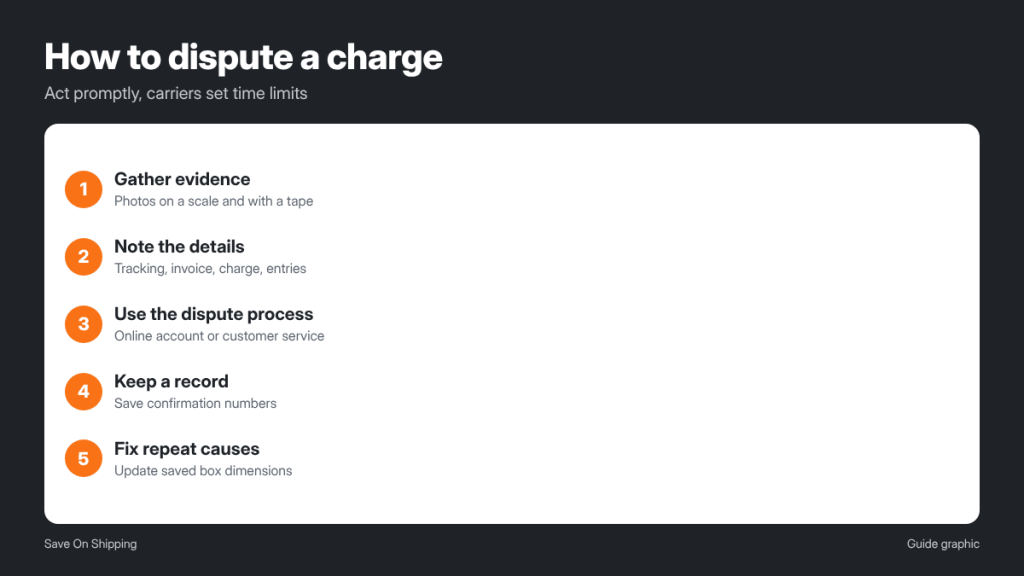
How to dispute a charge
Not every adjustment is correct. Automated equipment can misread a package, especially an irregular one, and addresses can be misclassified. If you believe a charge is wrong, act promptly, because carriers generally set a time limit for disputes in their service terms.
- Gather evidence. Photos of the packed box on a scale and next to a tape measure are the strongest proof. Keep these for higher-value or frequently adjusted shipments.
- Note the details. Have the tracking number, invoice number, the charge and your entered values ready.
- Use the carrier’s dispute process. FedEx and UPS both allow billing disputes through their online account tools and customer service. Follow the process the carrier lists on your invoice or account page.
- Keep a record. Save confirmation numbers and responses so you can follow up if needed.
If you see the same adjustment repeatedly on the same box type, fix the root cause rather than disputing each one. Repeated adjustments usually mean the saved dimensions or weight are slightly off.
Frequently asked questions
Why was I charged more after my package shipped?
The carrier likely measured, weighed or verified the package and found something different from what was on the label, such as a heavier weight, larger dimensions or a residential address. The difference is billed as an adjustment.
Do USPS labels get adjusted too?
USPS can also assess postage due when packages are underpaid, for example when the entered weight or dimensions are lower than the actual package. Accurate data matters with every carrier.
How often should I review my shipping invoices?
Every billing cycle if you ship regularly. A short review each period is much easier than trying to dispute charges that are several months old.
Can I avoid adjustments if I ship at a store?
When staff weigh and measure your package at the counter, the label is based on actual measurements, which greatly reduces the chance of a later correction.
Tired of surprise shipping charges?
Have your package weighed and measured at the counter before the label prints. The Postal Spot is a UPS Authorized Shipping Outlet in Houston that ships with accurate weights and dimensions from the start.