How to Save Money on Shipping: The Complete Guide
Shipping costs have a way of creeping up. You pick a box that looks about right, choose a service that sounds fast enough, and the total at checkout is higher than you expected. Do that a few times a month and the money adds up quickly, whether you are sending gifts to family or orders to customers.
The good news is that most of what drives a shipping price is under your control. This guide walks through every major lever: how carriers actually calculate your price, how to pick the right box and service, when each carrier tends to win, and the habits that keep surcharges and adjustments off your bill. Work through it once and you will have a repeatable system for every package you send.
Understand what you are actually paying for
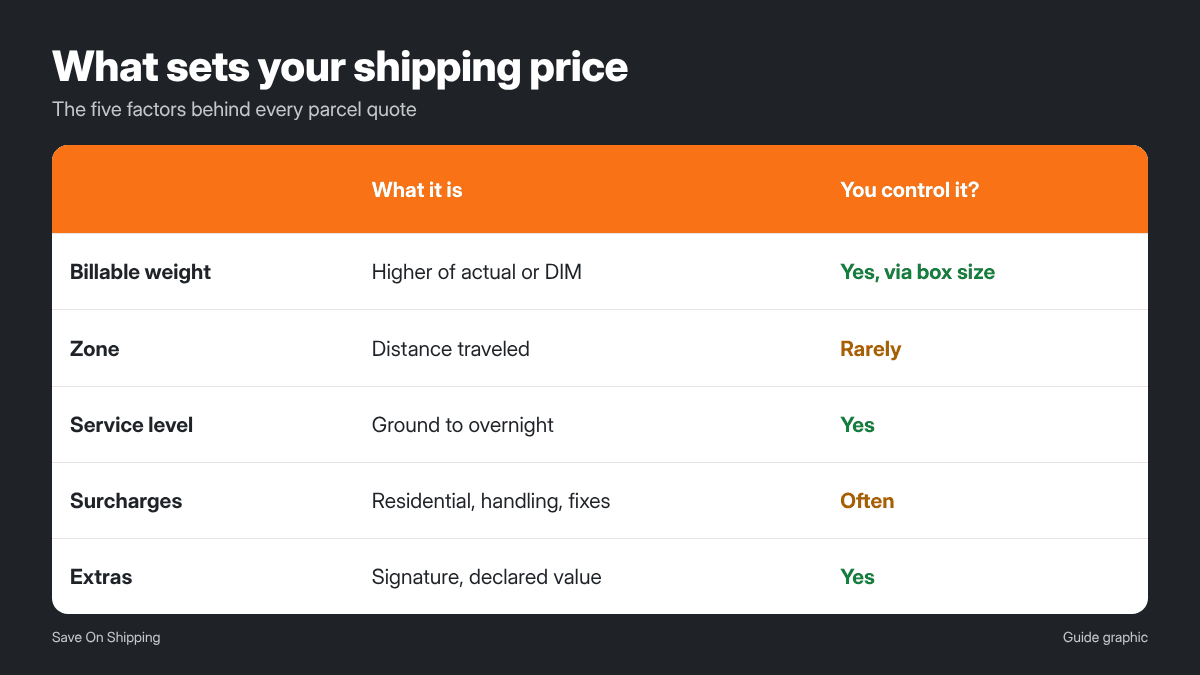
Before you can save, you need to know what goes into the price. Every domestic parcel quote is built from a handful of factors:
- Billable weight: the higher of the package’s actual weight or its dimensional weight.
- Zone: how far the package travels from origin to destination. Longer distances cost more.
- Service level: how fast the carrier promises to deliver it. Ground is cheapest, overnight is the most expensive.
- Surcharges: extra charges for things like residential delivery, remote areas, fuel, large or awkward packages, and address corrections.
- Optional extras: signature confirmation, added insurance or declared value, and similar add-ons.
Most people focus only on the carrier name. In practice, billable weight and service level usually move the price far more than the logo on the truck.
Shrink your billable weight
Dimensional weight is the single biggest hidden cost in parcel shipping. FedEx and UPS apply it to every package on their standard published rates. USPS applies it only to packages larger than 1 cubic foot (1,728 cubic inches). All three use the same formula on published rates:
Length x Width x Height (in inches) / 139 = dimensional weight in pounds
Round each side up to the next whole inch, then round the result up to the next pound. You pay for whichever is higher, actual weight or dimensional weight.
Worked example: the same item in two boxes
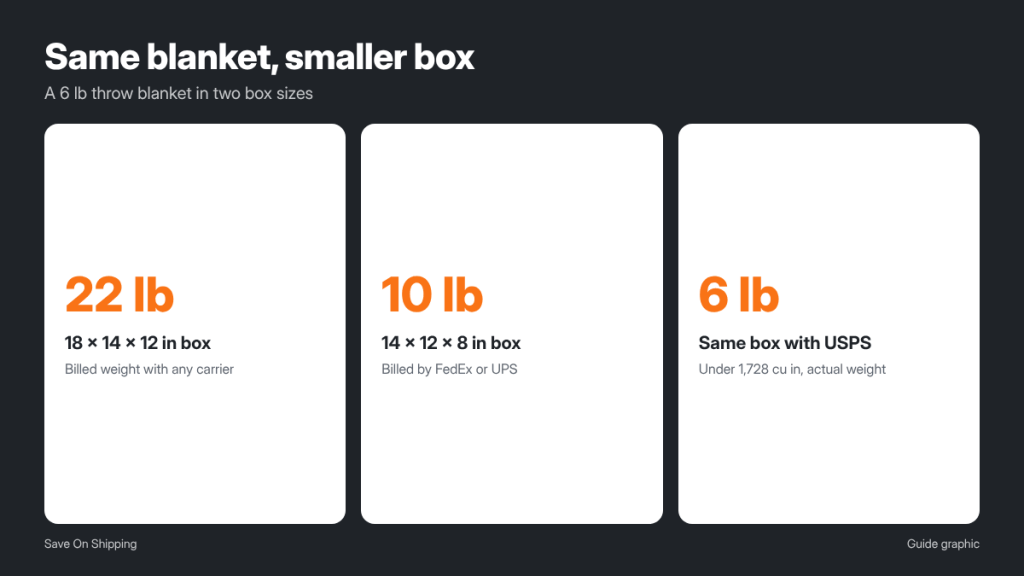
You are shipping a 6 pound throw blanket.
- In an 18 x 14 x 12 inch box: 18 x 14 x 12 = 3,024 cubic inches. 3,024 / 139 = 21.8, rounded up to 22 pounds billable.
- In a 14 x 12 x 8 inch box: 14 x 12 x 8 = 1,344 cubic inches. 1,344 / 139 = 9.7, rounded up to 10 pounds billable with FedEx or UPS. With USPS, the box is under 1,728 cubic inches, so you pay for the actual 6 pounds.
Same blanket, same destination, and the billable weight drops from 22 pounds to 10 or even 6. Nothing else you do will save as much as getting the box size right.
Practical ways to cut billable weight
- Keep three to five box sizes on hand so you are never forced into a box that is too big.
- Use poly mailers for clothing, linens and other soft items that do not need crush protection.
- Cut down tall boxes by scoring the corners and folding the flaps at a lower height.
- Remove bulky retail packaging when the product itself is sturdy and does not need it.
- Measure after packing, not before. A bulging box measures larger than its printed size.
Match the service to the real deadline
Paying for speed you do not need is the second most common way people overspend. Ask one question before you choose a service: when does this actually need to arrive?
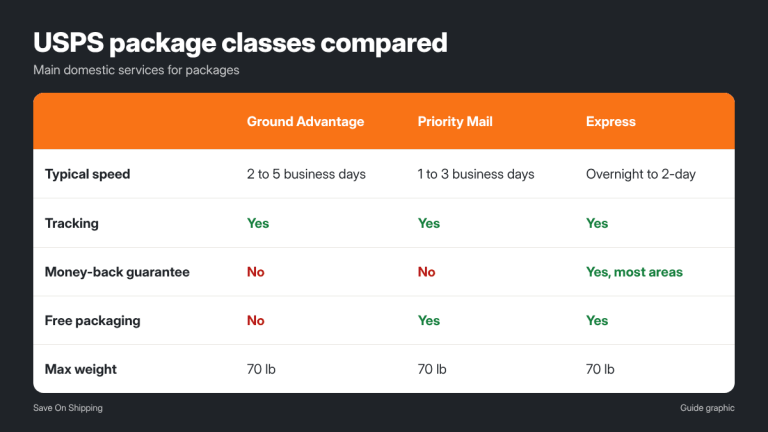
- No fixed date: ground services from any carrier, or USPS Ground Advantage, are usually the cheapest choice.
- Within a few days: check ground transit times first. For many routes, ground arrives in two to four business days, which is often as fast as a mid-tier air service.
- A firm date: compare a two-day or three-day air service against overnight. The middle option is frequently enough.
- Tomorrow: overnight is the only reliable option, so focus on keeping the package small and light.
The habit that saves the most money here is simply shipping earlier. If you send a gift three days sooner, ground service often does the job that overnight would have done at a much higher price.
Compare carriers by package type, not by habit
No single carrier is always cheapest. The winner changes with the size, weight and destination of each package. A few general patterns hold up well:
- Small, light packages: USPS is often hard to beat, especially for anything under 1 cubic foot, because it does not apply dimensional weight to those boxes.
- Small, heavy packages: a USPS Flat Rate box can be the best deal for dense items like tools or books, since weight does not change the price up to the limit.
- Larger and heavier packages: FedEx and UPS ground services are often competitive, particularly for business addresses.
- Time-critical shipments: compare overnight and two-day services across all three, because the gap between carriers can be wide.
The only way to know for sure is to get quotes for the exact package. Weigh it, measure it, and compare at least two carriers before you buy a label.
Avoid the surcharges you can control
Some surcharges are unavoidable, like delivery to a remote area. Others are the result of small, fixable mistakes.
Address corrections
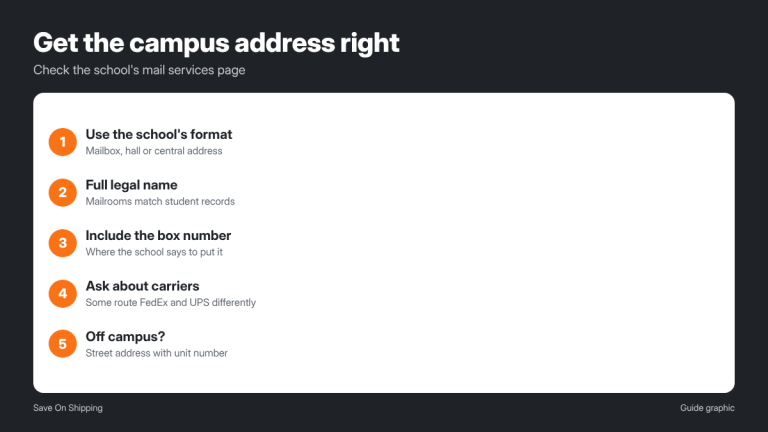
A wrong suite number, a missing apartment number or a misspelled street can trigger an address correction charge. Copy addresses carefully, include unit numbers, and verify ZIP codes before you print a label.
Residential delivery
FedEx and UPS add a charge for delivering to homes. If the recipient can receive the package at a business address, or pick it up at a carrier location, you may avoid it.
Additional handling and oversize
Very long, very heavy or oddly shaped packages, and items not fully enclosed in a corrugated box, can trigger handling charges. Box items properly and keep the longest side as short as practical.
Billing adjustments
Carriers measure and weigh packages in their facilities. If what you entered does not match what they find, they bill the difference later. Enter accurate weights and dimensions every time.
Pack smarter so nothing comes back
A damaged item costs you far more than the original shipping: you pay to ship a replacement, you lose time on a claim, and you may lose a customer or disappoint a recipient. Good packing is a cost saving in its own right.
- Use a sturdy corrugated box in good condition. Avoid boxes that are crushed, wet or heavily reused.
- Leave about 2 inches of cushioning on every side of fragile items.
- Fill empty space so nothing shifts when you shake the box.
- Seal every seam with pressure-sensitive packing tape using the H-tape pattern.
- Remove or fully cover old labels and barcodes.
Build habits that save money every week
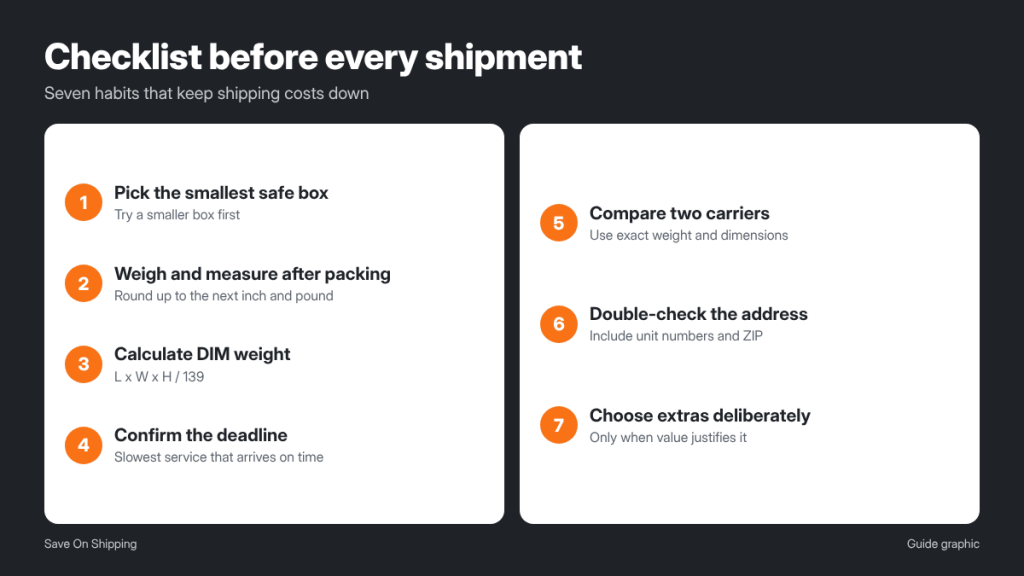
Individual tricks help, but routines are what keep costs low over time. Here is a simple checklist to run before every shipment:
- Pick the smallest safe box. Try the item in a smaller box before reaching for a bigger one.
- Weigh and measure after packing. Round up to the next inch and pound.
- Calculate dimensional weight. Multiply the three sides and divide by 139 to see if size or weight sets the price.
- Confirm the deadline. Choose the slowest service that still arrives on time.
- Compare at least two carriers. Use the exact weight and dimensions for each quote.
- Double-check the address. Include unit numbers and verify the ZIP code.
- Decide on extras deliberately. Add signature or declared value only when the item’s value or importance justifies it.
If you ship regularly, also consider combining orders going to the same address into one box, scheduling free carrier pickups instead of making extra trips, and buying postage online where online pricing is lower than retail counter pricing.
Frequently asked questions
What is the cheapest way to ship a package?
There is no single answer, because the cheapest option depends on size, weight, distance and deadline. For small, light packages, USPS Ground Advantage is often the lowest price. For larger boxes, compare ground services from all three carriers using the exact dimensions.
Does a smaller box really save money?
Usually, yes. For any package where dimensional weight is higher than actual weight, reducing each side by an inch or two can lower the billable weight noticeably, as the blanket example above shows.
Is it cheaper to ship from home or at a store?
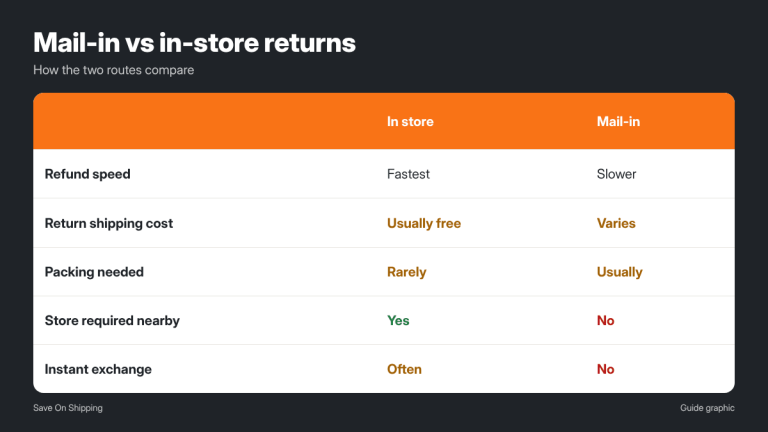
Buying labels online sometimes costs less than retail counter rates, but a multi-carrier store can compare carriers for you, repack items into smaller boxes and catch mistakes that would lead to adjustments.
How can I avoid surprise charges after shipping?
Enter accurate weights and dimensions, double-check every address, and pack items fully inside a corrugated box. Those three habits prevent most after-the-fact billing adjustments.
Want a second opinion on your next package?
If you are in Houston, The Postal Spot compares FedEx, UPS and USPS options at the counter and can repack your item into a smaller box so you are not paying to ship air.