USPS Mail Classes Explained: How to Pick the Right Service
The Postal Service offers several ways to send the same item, and the price, speed and features can be very different from one to the next. Pick the wrong mail class and you either pay for speed you did not need or wait longer than you expected. Pick the right one and USPS is often one of the most affordable ways to ship within the United States.
This guide explains each major USPS mail class for domestic letters and packages, what each one is designed for, what is included, and how to choose between them. You will also find a simple decision process you can use at the counter or when you buy postage online.
What a mail class is
A mail class is the category of service USPS uses to price and handle a piece of mail. It sets the speed, the features that come included, the size and weight limits, and sometimes the type of content allowed. Each mail piece goes in exactly one class, and you choose it when you buy postage.
For everyday shipping, the classes fall into three groups: classes for letters and flat mail, classes for packages, and specialized or commercial classes that most individuals rarely use directly.
Letters and flats: First-Class Mail
First-Class Mail is the class for letters, postcards and large envelopes (often called flats). It is what you use for cards, bills, checks and documents that fit in an envelope.
- Best for: standard letters, postcards and large envelopes containing paper.
- Shape matters: letters and flats must meet size and flexibility rules. A rigid or lumpy envelope may be charged as a package or with a nonmachinable surcharge.
- Weight limit: First-Class Mail letters and flats have a low weight limit, so heavier envelopes move into package pricing.
- Tracking: not included by default for letters and flats, though you can add extra services such as Certified Mail.
If you are mailing anything thicker or stiffer than paper, such as a phone case or a small box, it is a package, not a letter.
Packages: the three main options
USPS Ground Advantage
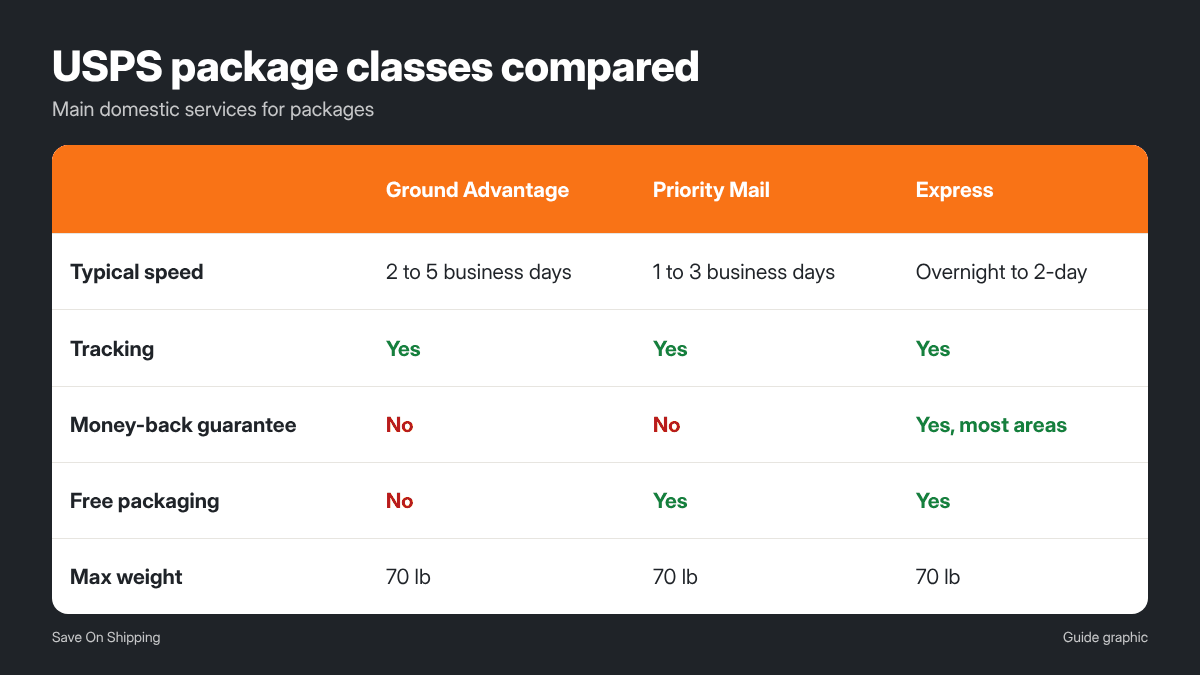
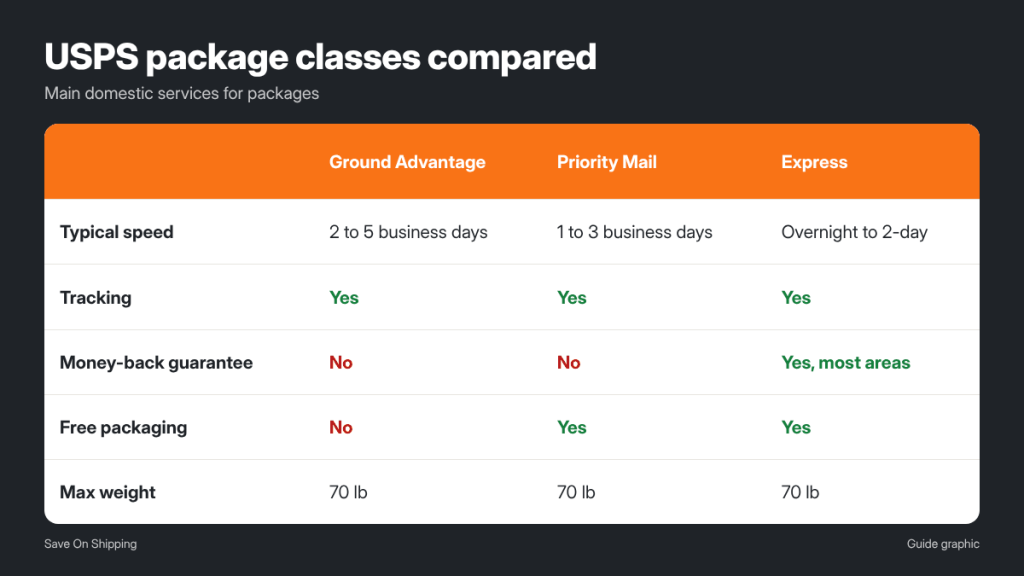
Ground Advantage is the Postal Service’s everyday, economical package service. It replaced First-Class Package Service and the retail ground service in July 2023. USPS advertises delivery in about 2 to 5 business days for most domestic destinations.
- Packages up to 70 pounds.
- Tracking included, plus a basic level of insurance for most packages.
- Usually the lowest-cost option for small, light packages, since dimensional weight does not apply to boxes under 1 cubic foot.
Priority Mail
Priority Mail is the faster package service, with USPS advertising delivery in about 1 to 3 business days for most destinations.
- Packages up to 70 pounds.
- Tracking and a basic level of insurance included for most packages.
- Free Priority Mail packaging available, including Flat Rate boxes and envelopes, where one price covers any weight up to the limit.
- Delivery dates are expected, not guaranteed.
Priority Mail Express
Priority Mail Express is the fastest USPS domestic service, with overnight to 2-day delivery to most U.S. addresses.
- Comes with a money-back guarantee for most destinations, subject to exceptions.
- Tracking, insurance and proof of delivery included.
- The most expensive USPS domestic option, so it is best saved for true deadlines.
Specialized and commercial classes
Media Mail
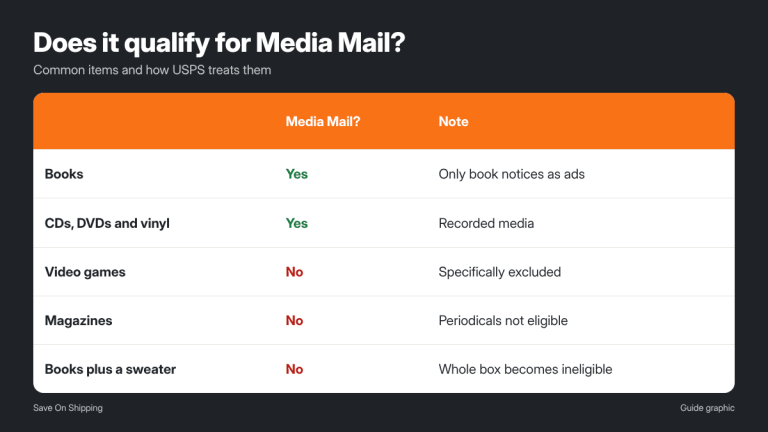
Media Mail is a lower-cost class limited to qualifying educational and media content, such as books, printed music, recorded media and certain educational materials. It cannot be used for advertising, games or general merchandise, and packages may be inspected to confirm the content qualifies. It is slower than Ground Advantage, so it is best for heavy books that are not in a hurry.
Library Mail
Library Mail is similar in concept but restricted to qualifying institutions such as libraries, schools and certain nonprofit organizations sending eligible materials.
USPS Marketing Mail
Marketing Mail is a bulk class for advertising and promotional mail. It requires a minimum volume per mailing, a permit and presorting, so it is aimed at businesses running mail campaigns rather than individual senders.
Parcel Select
Parcel Select is a commercial package service used by high-volume shippers who drop packages at USPS facilities closer to the destination. Individuals typically do not buy it directly, but your online orders may arrive through it.
How to choose the right mail class
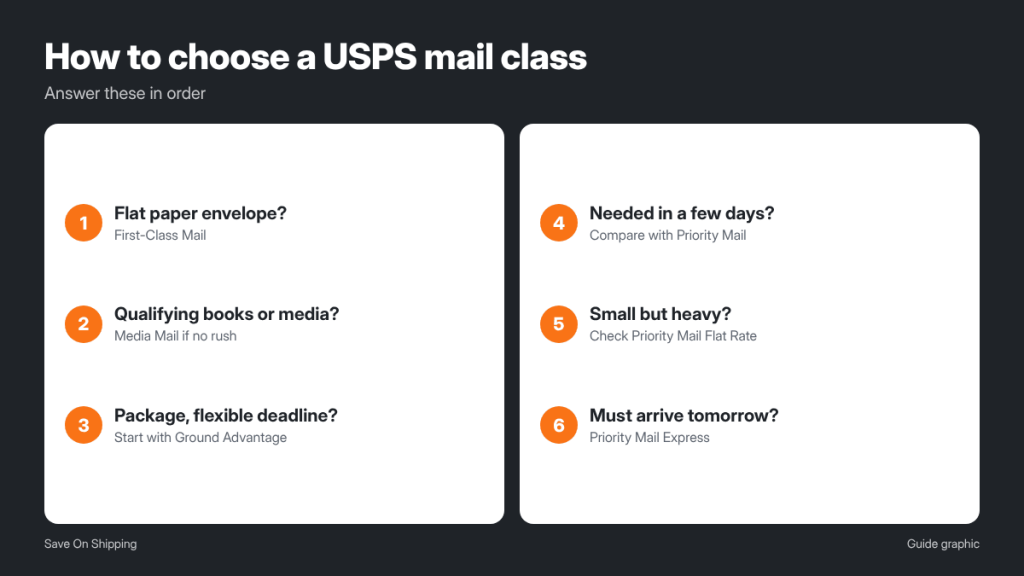
Work through these questions in order:
- Is it a flat, flexible envelope of paper? Use First-Class Mail. Add Certified Mail or another extra service if you need proof.
- Is it a qualifying book or media item, with no deadline? Media Mail may be the cheapest, as long as the content truly qualifies.
- Is it a package with a flexible deadline? Start with Ground Advantage.
- Does it need to arrive within a few days? Compare Priority Mail with Ground Advantage for your route. Sometimes the difference in transit time is small.
- Is it small but heavy? Check whether a Priority Mail Flat Rate box is cheaper than weight-based pricing.
- Does it have to arrive tomorrow or the next day, with a guarantee? Use Priority Mail Express.
Worked example: three packages, three classes
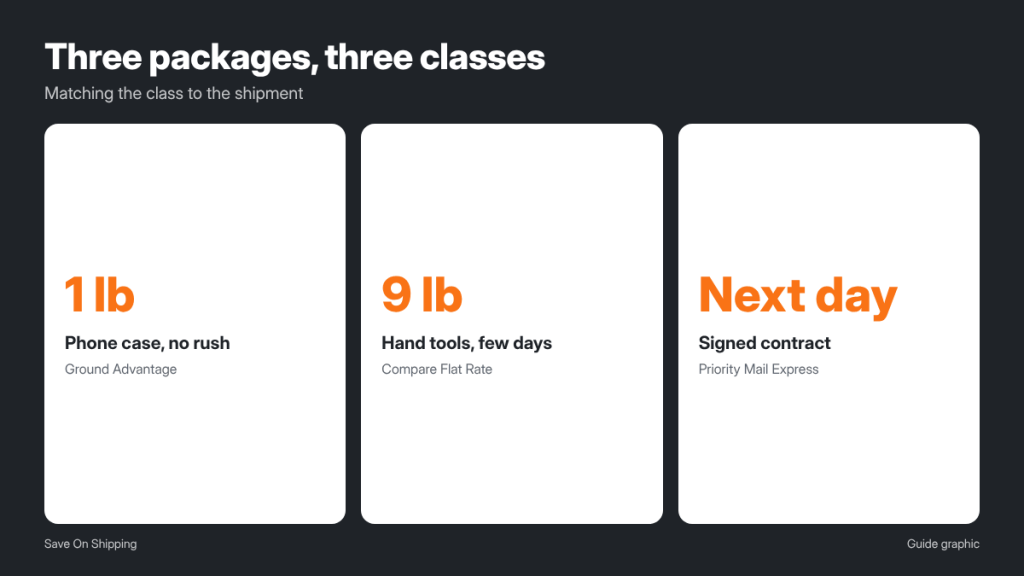
- A 1 pound phone case in a padded mailer going across the country, no rush: Ground Advantage.
- A 9 pound box of hand tools that fits in a Flat Rate box, needed within a few days: compare Priority Mail Flat Rate with weight-based Priority Mail. Heavy, compact items often favor Flat Rate.
- A signed contract that must arrive tomorrow: Priority Mail Express in a Flat Rate envelope.
Mail classes side by side
When you are standing at the counter, it helps to think about each class in terms of three questions: how fast, what is included, and what limits apply.
- Speed, slowest to fastest: Media Mail, then USPS Ground Advantage, then Priority Mail, then Priority Mail Express.
- Tracking: included with Ground Advantage, Priority Mail and Priority Mail Express. Not included with First-Class Mail letters and flats unless you add a service.
- Guarantee: only Priority Mail Express carries a money-back guarantee, and only for most destinations.
- Free packaging: available for Priority Mail and Priority Mail Express only.
- Content limits: Media Mail and Library Mail are restricted to qualifying items. The other classes accept general merchandise, subject to USPS rules on restricted and hazardous items.
- Dimensional weight: applies to Priority Mail, Priority Mail Express and Ground Advantage packages over 1 cubic foot. Flat Rate packaging is exempt.
Most everyday shipping decisions come down to Ground Advantage versus Priority Mail. A useful habit is to compare both for every package, because the gap in price and transit time changes with distance. For a nearby address, Ground Advantage may arrive almost as fast as Priority Mail. For a cross-country package with a deadline, Priority Mail’s shorter window can be worth the difference.
Common mistakes when choosing a mail class
- Using Media Mail for ineligible items. If inspected and found ineligible, the package can be returned or charged additional postage.
- Mailing a rigid item as a letter. Thick or rigid envelopes do not qualify for letter pricing.
- Assuming Priority Mail is guaranteed. Only Priority Mail Express carries a money-back guarantee.
- Reusing Priority Mail boxes for Ground Advantage. USPS-branded Priority Mail packaging is meant for Priority Mail services.
- Ignoring dimensional weight on large boxes. Packages over 1 cubic foot can be priced by size rather than weight.
Frequently asked questions
What is the cheapest USPS mail class for packages?
For most general merchandise, USPS Ground Advantage is the lowest-cost package option. Media Mail can be cheaper but only for qualifying books and media.
Is Priority Mail always faster than Ground Advantage?
Usually, but not always by much. On shorter routes, both may arrive in a similar number of days, so compare delivery estimates before you pay more.
Does every USPS package include tracking?
Ground Advantage, Priority Mail and Priority Mail Express include tracking. Letters and flats sent by First-Class Mail do not, unless you add an extra service.
Can I use Flat Rate boxes for any mail class?
No. Flat Rate boxes and envelopes are for Priority Mail and, for some envelopes, Priority Mail Express.
Want help picking a USPS service?
As a USPS approved shipper in Houston, The Postal Spot sells USPS postage and services and can compare mail classes for your package at the counter.