Returnless Refunds, Exchanges and Store Credit Explained
When you start a return, you might expect only one outcome: send the item back and get your money. In practice, retailers offer several different resolutions. Sometimes they refund you and tell you to keep the item. Sometimes they push you toward an exchange or store credit. Each option has different trade-offs in time, cost and flexibility, and the one a retailer suggests first is not always the best one for you.
This guide explains the main return outcomes, including returnless refunds, exchanges, store credit and standard refunds, when each one tends to be offered, and how to decide which to choose. It also covers what to do with an item you are told to keep, and how to avoid problems with each type of resolution.
The four main return outcomes
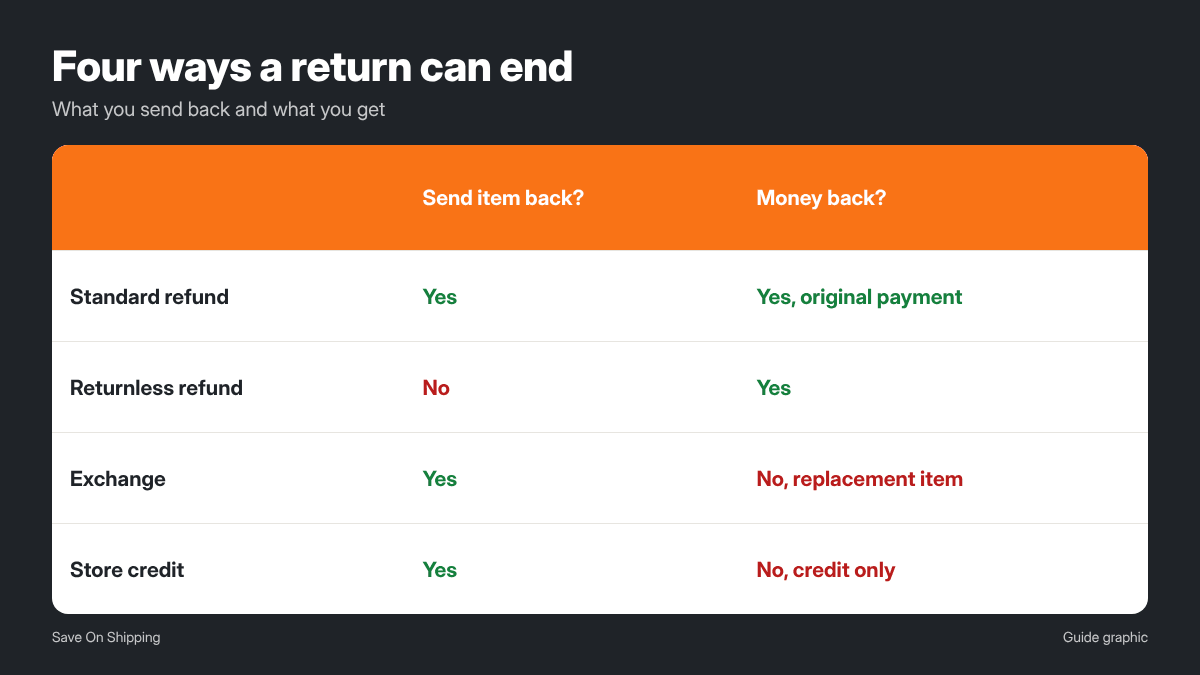
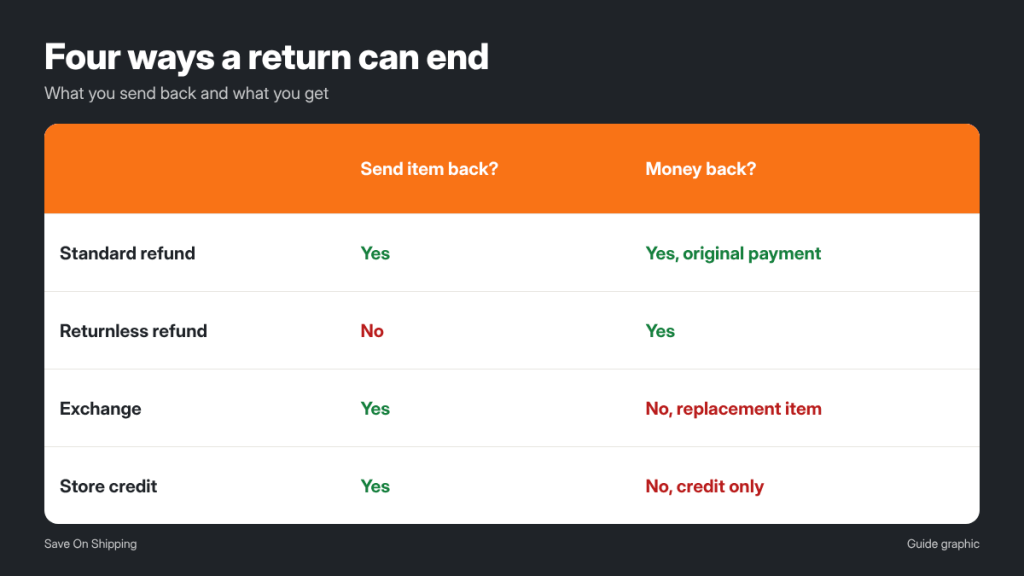
Almost every return ends in one of these four ways:
- Standard refund: you send the item back and the money goes back to your original payment method.
- Returnless refund: the retailer refunds you without requiring the item to be sent back.
- Exchange: you send the item back and receive a replacement, a different size or color, or another product.
- Store credit: you send the item back and receive credit you can spend only with that retailer.
Some retailers also offer a partial refund, where you keep an item with a minor flaw in exchange for part of your money back.
Returnless refunds: what they are and why they exist
A returnless refund is exactly what it sounds like: the retailer gives you a refund and tells you to keep, donate or dispose of the item. It can feel surprising, but there is a simple business reason. For some products, the cost of shipping the item back, inspecting it and restocking or disposing of it is more than the item is worth to the retailer.
When returnless refunds are most common
- Low-cost items where return shipping would cost a large share of the price.
- Bulky or heavy items that are expensive to ship back by parcel.
- Perishable or hygiene items that cannot be resold once opened.
- Items damaged in transit where the retailer does not need the item for a carrier claim.
What you cannot count on
Returnless refunds are a retailer’s decision, usually made case by case or by automated rules. You cannot request one as a right, and the same retailer may offer it for one item and not another. Do not dispose of an item until the retailer clearly confirms in writing that you do not need to return it.
What to do with an item you are told to keep
- Save the message confirming you do not need to return it.
- If the item is usable, consider donating it or giving it to someone who can use it.
- If it is damaged or unsafe, dispose of it responsibly, following local rules for electronics or batteries.
Exchanges: best when you still want the product
An exchange makes sense when the product was right but the size, color or variation was wrong. Many retailers make exchanges easy, and some ship the replacement before your return arrives.
Advantages
- You get what you wanted without placing a new order.
- Some retailers offer free shipping on exchanges even when returns are not free.
- You avoid the risk of the item going out of stock or rising in price before you reorder.
Watch out for
- Price differences. If the replacement costs more or less, check how the difference is handled.
- Advance replacement holds. If the retailer ships the new item first, it may place a hold or charge on your card until the original arrives back.
- Exchange deadlines. Exchanges usually follow the same window as returns.
Store credit: flexible for the retailer, less so for you
Store credit gives you value to spend with the same retailer, sometimes as a gift card or account balance. Retailers like it because the money stays with them. For you, it can be fine if you shop there often, and frustrating if you do not.
Questions to ask before accepting store credit
- Does the credit expire?
- Can it be used online and in stores?
- Is it tied to your account, or a code that can be lost?
- Is store credit your only option, or is a refund to your card available if you ask?
Some retailers offer a bonus, such as a little extra value, if you choose store credit instead of a refund. That can be worth it if you were planning to buy from them again anyway.
Standard refunds: the most flexible outcome
A refund to your original payment method gives you the most freedom: the money is yours to spend anywhere. The trade-off is time. You typically wait for the item to travel back, for the retailer to process it, and then for your bank or card issuer to post the credit.
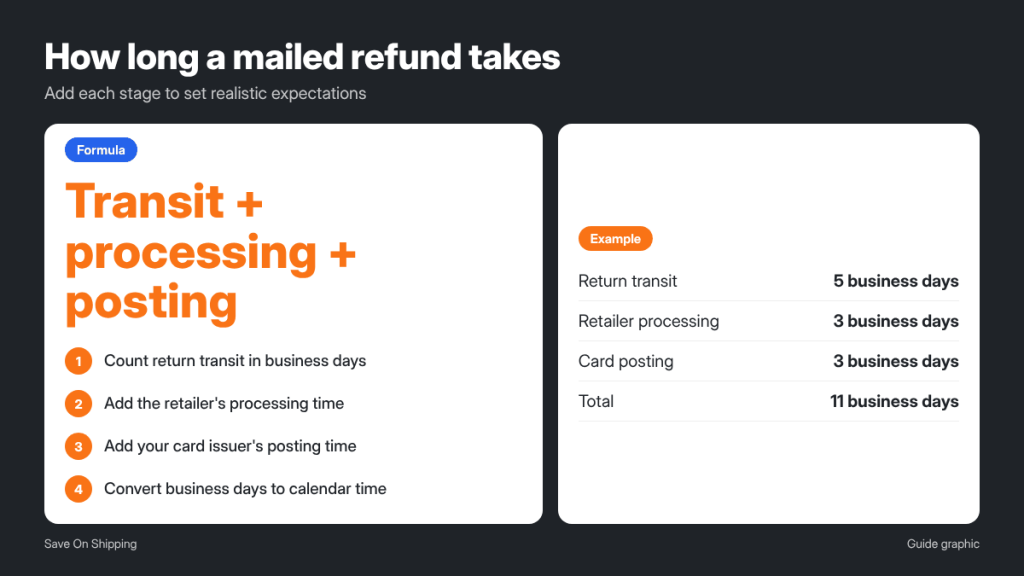
Worked example: how long a refund takes
Suppose return shipping takes 5 business days, the retailer takes 3 business days to process the return after it arrives, and your card issuer takes another 3 business days to post the credit. That is 5 + 3 + 3 = 11 business days, a little over two weeks on the calendar. Knowing this helps you decide whether an exchange or store credit, which may arrive faster, is the better option for a particular return.

How to choose the right outcome
Use these questions to pick the best resolution for each return:
- Do you still want the product? If yes, an exchange is usually fastest.
- Will you shop with this retailer again soon? If yes, store credit may be fine, especially with a bonus.
- Do you need the money back? Ask for a refund to your original payment method.
- Was the item damaged or wrong? Report it with photos. You may be offered a returnless refund, a replacement or a free return label.
- Is the item bulky or low-cost? Ask whether a returnless refund is possible before paying to ship it back.
Partial refunds for minor problems
If an item arrives with a small scratch, a missing minor accessory or a cosmetic flaw that does not affect how it works, you may be able to keep it in exchange for a partial refund. This avoids the hassle of packing and shipping it back and can be a good deal if you were happy with the item otherwise. Ask the retailer with photos of the issue, and get the agreed amount confirmed in writing. Be aware that accepting a partial refund usually ends your right to return the item for that problem later, so only agree if you are sure you want to keep it.
Keep a record of every resolution
Whichever outcome you choose, save the confirmation email, the return authorization number and the tracking number for anything you ship back. If you drop off a package, keep the receipt. These records protect you if the refund, credit or exchange does not arrive as promised.
It also helps to note the date you expect each outcome. If a refund should post within a stated number of business days after the retailer receives your return, put a reminder on your calendar for that date. If nothing has appeared by then, contact the retailer with your order number and tracking number ready. Following up promptly is much easier than trying to piece together the details weeks later.
Frequently asked questions
Can I ask for a returnless refund?
You can ask, especially for a damaged, bulky or low-cost item, but the retailer decides. Never dispose of the item until you have written confirmation.
Is store credit the same as a refund?
No. A refund returns money to your payment method. Store credit can only be spent with that retailer and may have expiration rules.
Why do exchanges sometimes put a hold on my card?
If the retailer ships the replacement before receiving your return, it may hold or charge the amount until the original item arrives back.
How can I speed up a refund?
Start the return early, ship it promptly with tracking, and drop it off at a staffed location where you get a receipt. Faster transit means a faster refund.
Sending a return back for a refund or exchange?
In Houston, drop off prepaid returns at The Postal Spot for FedEx, UPS, USPS and Amazon, and leave with a receipt that proves when your return went out.