Ship Gifts Direct From the Store or Send Them Yourself?
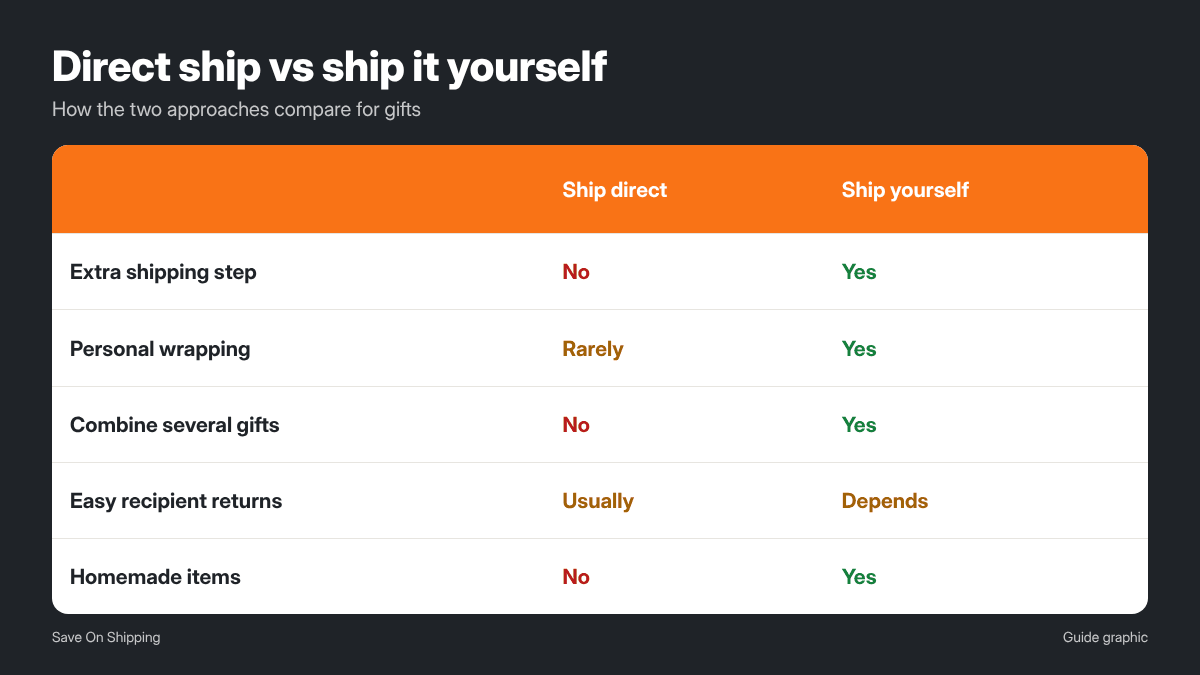
Every holiday season brings the same decision for gifts going to people far away. You can order online and have the retailer ship straight to the recipient, or you can buy the gift, bring it home, wrap it and send it yourself. Both approaches work, but they differ a lot in cost, timing, presentation and how much can go wrong.
This guide compares shipping gifts directly from the store with shipping them yourself. It covers the real costs on each side, how to keep the price and packing slip out of the box, when consolidating several gifts into one package makes sense, and a simple way to decide for each person on your list.
Option 1: ship directly from the retailer
When you order online, you enter the recipient’s address as the shipping address and the retailer sends it straight to them. Many sites let you mark the order as a gift.
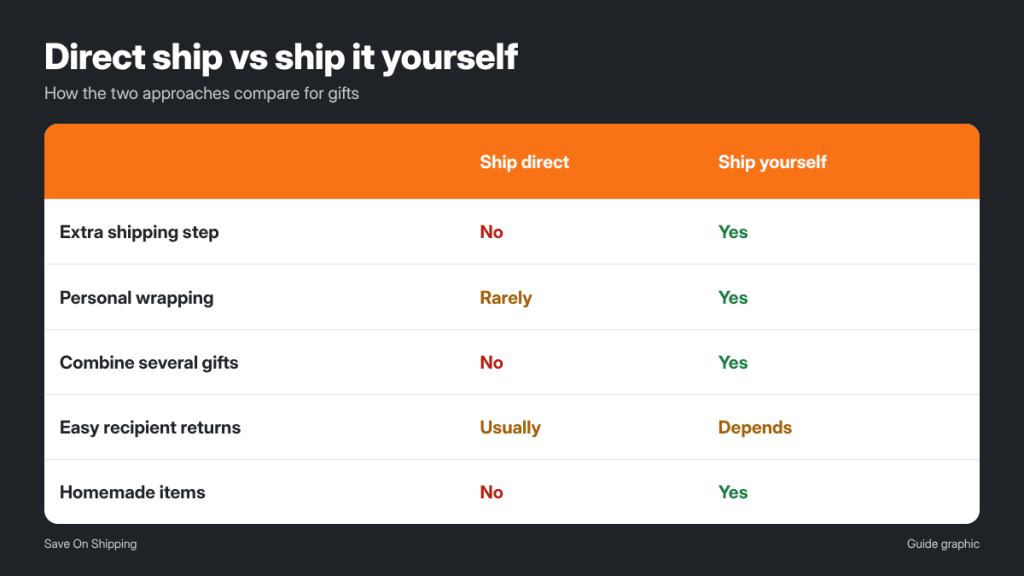
Advantages
- No extra shipping step. You skip the trip to a shipping counter and the cost of a second shipment.
- Free shipping thresholds. Many retailers offer free or reduced shipping above a minimum order, which can make direct shipping very cheap.
- Retailer packaging. The item ships in packaging designed for it.
- Gift options. Some retailers offer gift messages, gift wrap or gift receipts.
- Easier returns. The recipient can return or exchange using the retailer’s process.
Drawbacks
- Less personal. The gift arrives in a plain shipping box, and gift wrap options are limited.
- Multiple boxes. Gifts from different retailers arrive separately, on different days.
- Price exposure. If you do not choose gift options, a packing slip with prices may be included.
- Less control. You rely on the retailer’s stock, shipping speed and carrier choice.
- Spoiled surprises. Tracking emails and branded boxes can give away the gift.
Option 2: ship it yourself
You buy the gift online or in a store, have it delivered to you, then wrap and ship it to the recipient.
Advantages
- Personal presentation. You choose the wrapping, add a handwritten card and include small extras.
- Consolidation. You can combine gifts from several stores into one box, often for less than separate shipments.
- Control over timing. You decide the service level and ship date.
- Quality check. You see the gift before it goes out, so you can catch damage or a wrong item.
- Homemade items. The only way to send baked goods, crafts or hand-me-downs.
Drawbacks
- Double shipping. If the item was shipped to you first, you pay to ship it a second time.
- Time and effort. Packing, labeling and a trip to drop it off.
- Packing risk. Wrapped gifts still need proper boxes and cushioning.
- Harder returns. The recipient may need your help to return or exchange.
Comparing the real cost
The cheaper option depends on how many gifts are going to the same person and whether the retailer offers free shipping.
Worked example: three gifts for one person
You are sending three gifts to your sister: a sweater, a book and a candle, each from a different retailer.
- Shipping direct: three separate orders, three boxes, and three separate shipping charges unless each order qualifies for free shipping on its own.
- Shipping yourself: each item ships to you (often free if you meet thresholds or pick up in store), then you send one consolidated box.
If two of the three retailers charge for shipping and the third ships free, shipping direct means paying two shipping charges. Shipping yourself means paying for one consolidated package, plus any shipping to you. When most items can be picked up in store or ship free to you, consolidating usually wins. When every retailer ships free to any address, direct shipping is hard to beat.
Watch the box size
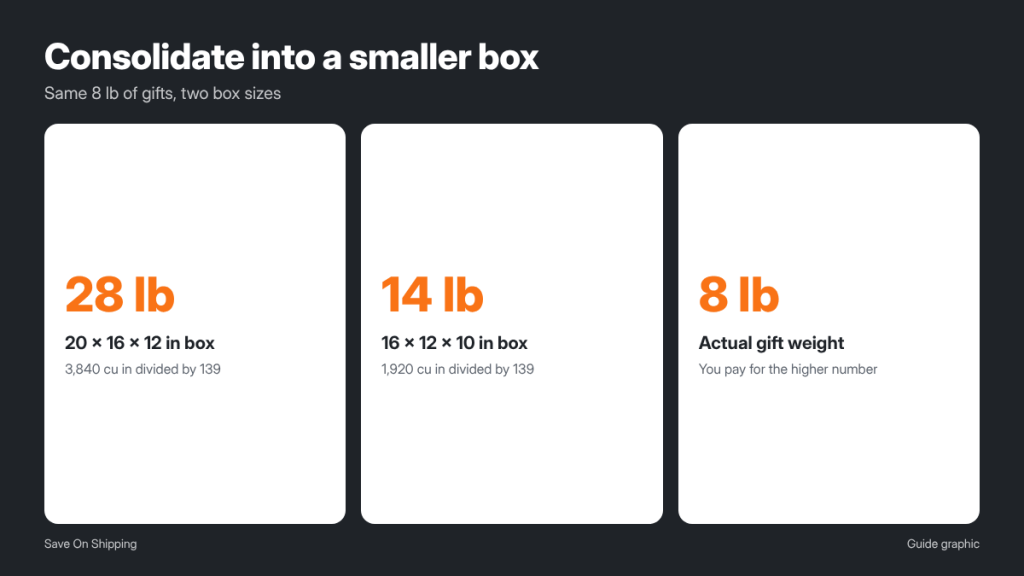
When consolidating, choose the smallest box that fits all the gifts with cushioning. Carriers price larger boxes by dimensional weight, so a big box with lots of empty space can cost more than expected. For example, a 20 x 16 x 12 inch box is 3,840 cubic inches, and 3,840 / 139 = 27.6, so it bills as 28 pounds even if the gifts weigh only 8. Fitting the same gifts into a 16 x 12 x 10 inch box (1,920 cubic inches) drops the dimensional weight to 1,920 / 139 = 13.8, or 14 pounds.
Keeping the surprise and the price hidden
If you ship direct:
- Choose “This is a gift” or a gift option at checkout so prices are left off the packing slip.
- Add a gift message so the recipient knows who it is from.
- Consider a gift receipt, which allows exchanges without showing what you paid.
- Give the recipient a heads-up that a box is coming, but not what is inside.
- Be aware that some recipients will see the retailer’s name on the box or in tracking notifications.
If you ship yourself:
- Remove price tags and receipts before wrapping.
- Include gift receipts in a separate envelope if the retailer provides them.
- Use a plain outer box. Never ship a wrapped gift without an outer shipping box.
- Add “Do not open until” on the inner wrapping rather than the outside of the shipping box.
How to decide for each person on your list
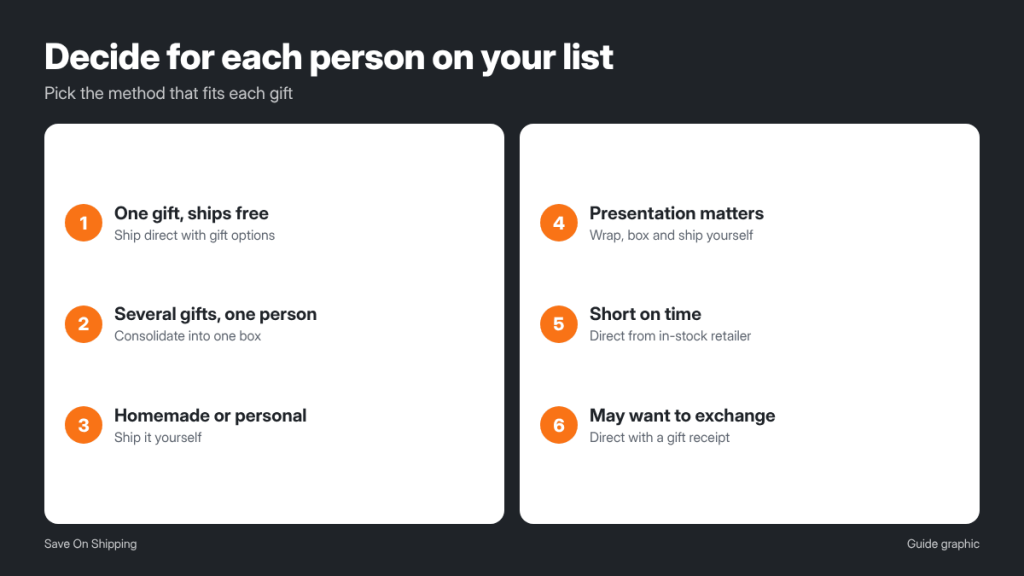
- One gift, retailer ships free: ship direct with gift options.
- Several gifts to one person: consider having them sent to you and shipping one consolidated box.
- Homemade or personal items: ship yourself.
- Presentation matters a lot: ship yourself, wrapped and boxed.
- Short on time close to the holiday: ship direct from a retailer with in-stock items and a clear delivery estimate.
- Recipient may want to exchange it: ship direct with a gift receipt.
Mixing both approaches
You do not have to pick one method for your whole list. Many people ship most gifts direct and send one personal box themselves to close family, with handwritten cards and a homemade treat. Others order everything to their own address in early December, check each item, and then ship a single box per household. A mixed plan lets you use free retailer shipping where it helps and your own packing where presentation or consolidation matters.
How to pack gifts you ship yourself
- Wrap first, then box. Wrap each gift, then place it inside a sturdy shipping box, never the other way around.
- Protect bows and ribbons. Flatten bows or pack them separately so they do not get crushed.
- Cushion between gifts. Use crumpled paper or bubble wrap so gifts do not rub and tear the paper.
- Add a card list. If the box holds gifts for several people, label each gift clearly with the recipient’s name.
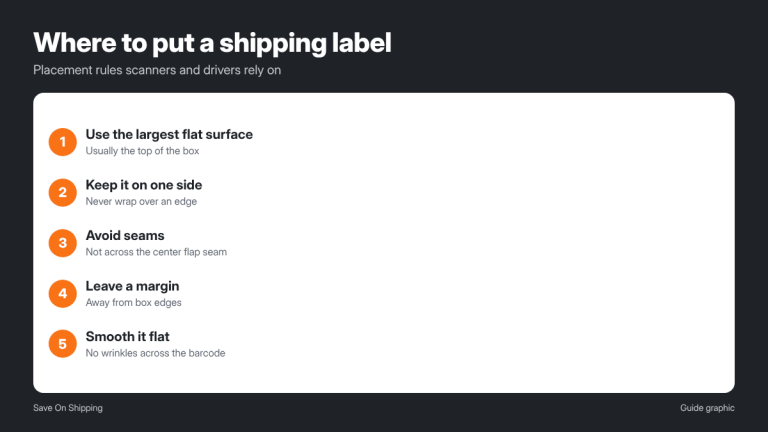
- Seal with the H-tape method and put the shipping label on top, away from seams.
Timing tips for both options
- Order direct-ship gifts early, since retailer processing time is added on top of carrier transit.
- If shipping yourself, allow time for the item to reach you first, then for your own shipment.
- Check carrier holiday shipping deadlines for the service you plan to use.
- Choose ground service if you have time, and save faster services for late gifts.
- Share tracking numbers with yourself, not the recipient, if you want to keep the surprise.
Frequently asked questions
Is it cheaper to ship a gift directly from the store?
It often is when the retailer offers free shipping to any address. If you are sending several gifts to the same person, consolidating them into one box can be cheaper.
Will the recipient see the price on a direct shipment?
Not if you select the retailer’s gift option, which typically removes prices from the packing slip. Check the option before you complete the order.
Can I ship a wrapped gift without a box?
No. Wrapping paper is not shipping protection. Always place wrapped gifts inside a sturdy shipping box with cushioning.
How can I combine gifts from different stores?
Have each item shipped to you or pick it up in store, then pack them together in one right-sized box with cushioning between items.
Sending a box of gifts yourself?
Houston gift-givers can bring presents to The Postal Spot for UPS holiday shipping, with packing help and FedEx and USPS options compared at the same counter.